
Replacing fascias and soffits is more than swapping boards. Access, checks on the timber behind, ventilation and gutters all come into it. Here is the process for a Pucklechurch house, step by step.
The boards along your eaves may look like a simple strip of trim, but replacing them is a proper job with several stages. On cottages and village houses, what lies behind can differ from house to house, so the work begins with looking, not with ordering boards.
Access comes first
Fascias and soffits sit at roof-edge height, so we put up scaffold or a proper working platform before anything else. That keeps the work safe and allows us to see and reach every board and joint. Lanes and driveways are considered so deliveries and access do not cause problems.
On a village house, the working area may be tight, with narrow paths or neighbouring walls close by. We plan where the scaffold goes and how materials come in, so access is arranged before the day, not improvised on it. Good planning here saves time and tempers on the day.
Taking down the old
Gutters are taken down first, then the old fascia and soffit boards are removed. On older homes, we check what the existing soffit boards are made of before disturbing them, and handle them accordingly. Old nails, brackets and rotten pieces are cleared so the eaves are ready for a clean start.
Checking what is behind
With the boards off, we can see the rafter ends and the wall plate. Damp or rotten timber is dealt with now, not boxed in. Sound ends are left as they are. On older stone and brick houses, uneven eaves are common, so boards are cut and packed to sit true.
Where stone or brick walls are uneven, boards are packed and cut to follow the line rather than forced straight. A little patience at this stage is what makes the finished eaves look right from the lane. Rushed fitting shows most on stone and older brick.
- Rafter ends checked for damp, rot and movement
- Wall plate and eaves timbers inspected
- Uneven or damaged sections made good
- Old fixings and debris cleared before new boards go on
Fitting the new boards
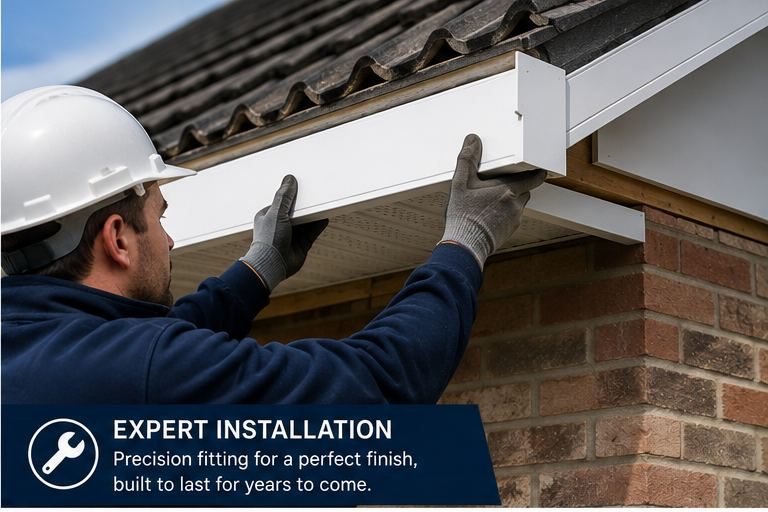
New UPVC fascias and soffits are fixed to the rafters, with vented soffits or vent strips so the roof space can breathe. Joints are closed with proper corner and joining pieces. Finishes include white, darker colours and wood-effect. UPVC is cleaned, not painted, and is very low maintenance.
Gutters and finishing
Gutters are refitted or replaced, with brackets set to the right fall so water runs to the downpipes. We check joints and outlets, clear away old boards and leave the site tidy. Ask for a written description of what is being removed, fitted and left, so there are no surprises.
At the end, the gutters are run with water to confirm they drain, and old boards and fixings are taken away. You should be able to see where each part was replaced and have a clear account of what was found behind.
Frequently Asked Questions
Do I need to replace the guttering too?
The gutters have to come off to replace the fascia, so they are either refitted or renewed. If they are old, sagging or leaking at joints, renewing them at the same time makes sense, but it is your decision.
Will my loft be affected?
Not directly, but ventilation is part of the job. Vented soffits or vent strips allow air into the roof space, which helps keep timbers and insulation dry. We explain what is being fitted and where. We explain what to expect first.
How disruptive is the work?
Most of it is outside the house, but scaffold is in place and some noise is unavoidable. We tell you what to expect, such as when gutters will be off, and keep the site tidy. We tell you what is being fitted.
Talk to our team about UPVC fascias and soffits in Pucklechurch
Every roof is different — the fastest way to get an accurate answer is a quick chat with our team.