
The roof edge of a Downs villa has three parts doing three jobs. Here is what each does, how wind and mature trees affect them and what to look for from the ground.
Look up at the eaves of a Victorian or Edwardian villa and you will see a board facing out, a board tucked beneath it and a gutter hanging from the front. They look like one unit, yet each has a separate job, and each fails in a different way on an exposed roof near the Downs.
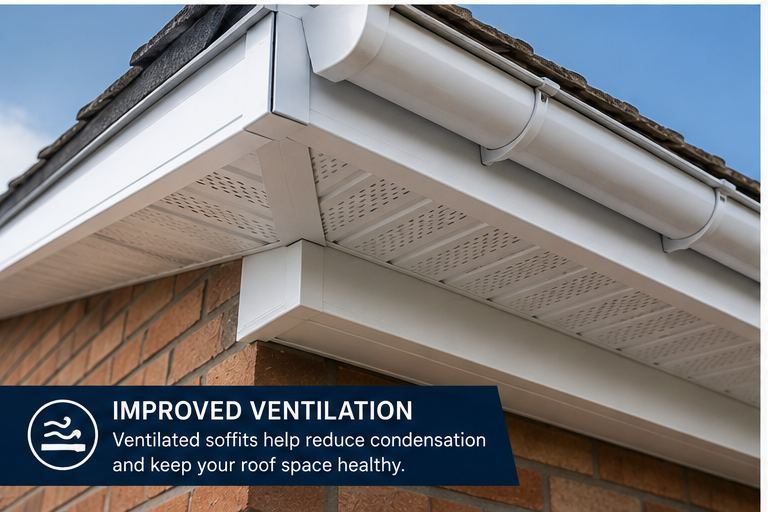
Fascia boards
The fascia is the board fixed to the ends of the rafters, facing outwards. It carries the gutter and finishes the edge of the roof. On windy sites it is pulled and pushed by gutters full of water, so its fixings and the timber behind get tested more than you might expect. That makes the fascia the first place trouble shows once a gutter starts to fail.
Soffit boards
The soffit closes the underside of the eaves, from the wall out to the fascia. It stops birds and weather getting into the roof space, and with vents or a vent strip it lets air move through, which helps keep the timbers and insulation dry.
Where soffits have broken or gone, birds and insects soon move in, and wind can drive rain up into the loft. A quick look from the ground for gaps, sagging boards or nesting material often tells us a good deal about the state of the eaves.
Guttering and downpipes
The gutter collects rain from the roof, and the downpipes carry it away. Under mature trees, gutters fill with leaves, seeds and twigs, then overflow, soaking the fascia and wall below. Regular clearing from the ground, using proper methods, helps, but repeated blockages are a reason to look closer.
- Overflowing in heavy rain or leaf fall
- Gutters sagging between the brackets
- Joints weeping or split open
- Downpipes blocked or leaning away from the wall
Bargeboards at the gables
At a gable, the board along the sloping edge is a bargeboard. It does the fascia's job on that side and takes the full force of wind at the roof edge. Villas with several gables have a good deal of bargeboard, and it needs the same checks as the other boards.
Repair, clean or replace
UPVC boards are cleaned, not painted, and are very low maintenance. Old timber boards that have rotted can be replaced with UPVC fascias, soffits and bargeboards, finished in white, darker colours or wood-effect options. A replacement means removing old boards and gutters, checking the rafter ends and eaves and fitting vented soffits.
On older houses, we check what the existing soffit boards are made of before disturbing them, and we carry on once we know what we are dealing with. The rafter ends are inspected whenever the old boards come away. Nothing is hidden, and we explain what we find at each stage.
Frequently Asked Questions
Which part usually fails first?
Often the gutter or its joints, because they hold water and carry the load of leaves. A leaking gutter then soaks the fascia behind it, so the problems tend to follow one another along the edge.
Why does wind damage fascias?
Wind pulls at gutters and boards, loosening fixings over time, and gusts can drive rain behind the boards. Exposed roofs near open ground see this more than sheltered ones, and mature trees add weight and debris to the gutters.
Can I clean them myself?
Light cleaning from the ground is fine, but please avoid jet washing or reaching up a ladder to the roof edge. If you can see sagging, rot or staining, call us and we can look properly.
Talk to our team about UPVC fascias and soffits in The Downs
Every roof is different — the fastest way to get an accurate answer is a quick chat with our team.