
A flat roof near the Downs faces wind, falling leaves and the occasional branch. Whether it can be repaired depends on the covering, the deck beneath and how widespread the damage has become.
Flat roofs on villas around the Downs take plenty of punishment: wind that tugs at the edges, leaves that choke the outlets and the odd fallen branch. Deciding whether to patch or replace is a judgement about the whole roof, not just the spot where water is currently getting through.
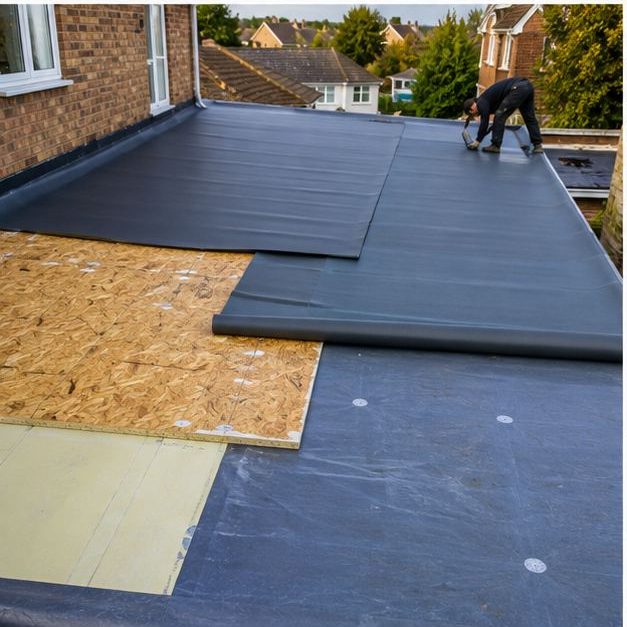
When a repair is the right call
If the covering is largely sound and the damage is local, a repair is sensible. A split from a falling branch, a lifted corner after a gale, a failed joint or a damaged patch near an outlet can be cut out and renewed without touching the rest.
We would rather tell you honestly that a repair will do than push a full replacement, and we explain what the repair covers so you know what you are getting and what the rest of the roof still needs. A short, honest list of what was found helps you decide.
When replacement is the honest answer
Widespread cracks, blisters across the surface, repeated leaks in different places and soft boards all point to a covering that has reached the end of its useful life. A replacement allows us to correct the falls, fit proper edge trims and put in insulation at the same time.
- Cracking over much of the surface
- Boards that feel soft or spongy underneath
- Repairs that keep reopening in new places
- Water that sits on the roof and never clears
What we check before saying
We check the covering, the edges, the outlets and the upstands. We feel for movement in the deck and look from inside for stains and damp timbers. Wind lifting an edge may only need a refix, but if it has pulled the covering loose across a large area that tells another story.
The deck and the trees
Water that gets under the covering rots the boards beneath, and a new membrane over soft boards will fail early. Overhanging trees make it worse, because wet leaves hold moisture against the roof. If boards are bad, we replace them as part of the job.
We also look at whether the outlets and gutters need larger or clearer routes to cope with leaf fall, since a roof that cannot shed water quickly will wear faster whatever the covering. Good drainage protects the covering for longer, and it is easiest to sort out while the roof is open.
What a good proposal should say
Whichever way it goes, ask for the diagnosis in writing: what is wrong, whether it is repair or replacement, and what the work involves. Ask how the edges will be finished and what happens if the deck proves rotten. A straight answer is better than a vague promise.
If the roof is old and has been patched before, tell us what has been done and when, because earlier repairs help us read the roof. Photographs of past work, or a note of any previous leaks, save time on the day and help us give you a clear answer.
Frequently Asked Questions
How can I tell my flat roof is nearing the end?
Cracking, blistering, ponding and recurring leaks are the main signs. A ceiling stain that returns after a repair is another. From the ground you can sometimes see sagging or standing water, and we confirm the rest on a proper inspection.
Is a patch repair a waste of effort?
Not when the rest of the roof is sound, because a local repair deals with the fault quickly and sensibly. It is a waste only where the roof is failing widely, and we tell you plainly if that is the case.
Can the roof be made more wind resistant?
Yes. A replacement lets us secure the covering properly and finish the edges with sound trims. Proper fixing and well-detailed edges matter more on exposed roofs than most people realise. We explain the options before any work begins.
Talk to our team about flat roofing in The Downs
Every roof is different — the fastest way to get an accurate answer is a quick chat with our team.