
Yes, in many cases. A dry verge can replace failed mortar on an existing roof, provided the tile profile is compatible and the roof edge is sound enough to take it.
Roofs on villas near the Downs lose their verge mortar to wind and weather sooner than sheltered ones. When it falls, fitting a dry verge to the existing roof is often the practical solution. Whether it works depends on the tiles, the edge and what lies beneath, and we check all three on site.
When the mortar has gone
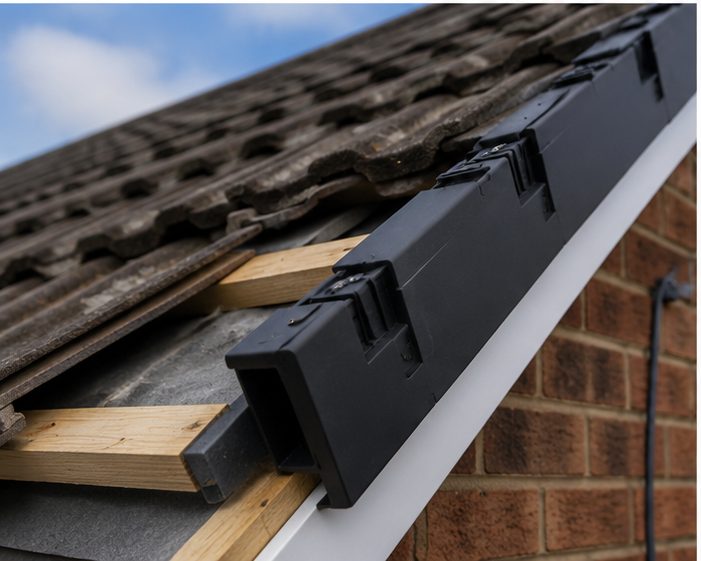
Pieces of mortar on a path, drive or lawn are a typical first sign. Once the bed has cracked, the edge tiles loosen, and in a gale they can lift. Dry verge units remove the need for mortar altogether, holding the edge with fixings instead, which suits roofs where repointing keeps failing. A roof in this condition usually has other signs too, so we look at the whole edge, not only the worst corner.
Which existing roofs suit it
It suits many roofs that are otherwise sound, particularly where the tiles are of a compatible profile. A dry verge deals with the edge only, so if the roof is failing elsewhere, with slipped tiles or worn felt, that should be sorted out as well.
On older villa roofs, the tiles may be a profile that needs a particular unit, which is why we look closely first, and why we would rather confirm compatibility on the roof than promise anything from a photograph. Nothing is left to guesswork.
What we check on site
We check the profile of the tiles, the state of the edge, the rafters, the battens and the undercloak. We also look at how the roof meets the wall and the fascia. Fixing follows the tile maker's guidance, so the system must be compatible, and we say plainly if it will not work.
- Tile profile and whether the units are compatible
- Condition of the battens and rafters
- State of the undercloak at the edge
- How the edge meets the wall and fascia
Preparing the edge
Old mortar is removed and loose or broken edge tiles are replaced. Any rotten timber at the edge is cut out and renewed so the new units are fixed to something solid. This preparation matters as much as the units themselves, because a dry verge is only as good as the edge it is fixed to.
What you get
The verge units and cap or end pieces are fixed mechanically to the maker's guidance. The result is a gable edge with no wet mortar to fail, better resistance to wind lifting at the edge, and a barrier against weather, birds and insects. Scaffolding or safe access is arranged beforehand.
Any work to a gable may need planning or Building Regulations checks — we advise before work starts. We also arrange safe access to the edge before anything begins, and tidy up the old mortar and debris afterwards. We explain how the system will finish at the ridge and the eaves, so you know exactly what to expect.
Frequently Asked Questions
Can any tile take a dry verge?
Not every one. The tile profile decides compatibility, and some older tiles need a specific unit. We check on site and tell you honestly if the roof will not suit, rather than fitting something that will not last.
Do I need to re-roof first?
Not necessarily. If the covering is sound, the verge can be fitted on its own. If the roof is failing more widely, we explain whether repairs or a re-roof make the better judgement, and what can wait.
How will I know if the mortar is failing?
Look from the ground for cracks or gaps along the edge, stains below it, and bits of mortar on paths or drives. If you notice any of these, call us for a proper look rather than waiting for a gale.
Talk to our team about dry verge systems in The Downs
Every roof is different — the fastest way to get an accurate answer is a quick chat with our team.