
There is a point where repainting and patching wooden fascias stops making sense. These are the signs to watch for on a Victorian terrace, and what replacement offers in return.
Rows of terraced houses in Redfield mean long runs of fascia board facing the street and the yard, all exposed to the same weather. Timber can serve for a long time when kept painted, but once water gets in it deteriorates quickly. Choosing the moment to replace avoids wasted effort.
Paint that will not hold
If paint keeps flaking within a season or two of redoing it, damp is probably coming from behind or from the gutter above. Repainting over wet timber just traps the problem. Scaffold is needed every time, so a board that demands constant attention soon becomes a poor use of effort and time.
A quick test is to look at the paint history. Several coats flaking in layers usually signals long-standing damp in the board, which means the wood is likely to be soft behind the surface. You can see the layers from the pavement or a window without going near the roof.
Boards that bend, split or open up
Timber that has lost its shape no longer sits tight against the rafters or soffit. Joints open, the board bows, and gaps let in rain, birds and insects. From the pavement you may see a wavy line along the eaves or dark gaps where boards meet. Those are signs the wood has reached the end of its useful life.
- Wavy fascia lines along the eaves
- Open joints between boards where light or rain gets in
- Staining from the gutter running down the wall
- Nests or insects at the roof edge, or daylight through gaps
Gutters that will not stay put
The fascia carries the gutter. When the board softens, brackets lose their grip and the gutter sags or tips. Leaks then run down the wall and soak the timber further. Replacing the fascia and gutter together is usually the cleanest solution, as the work needs the same access.
If the gutter has been refixed several times already and still drips at the joints, the board is almost certainly the root cause, not the gutter itself. Replacing both together stops the cycle and gives the new gutter a firm board to sit on.
Why UPVC makes sense in tight streets
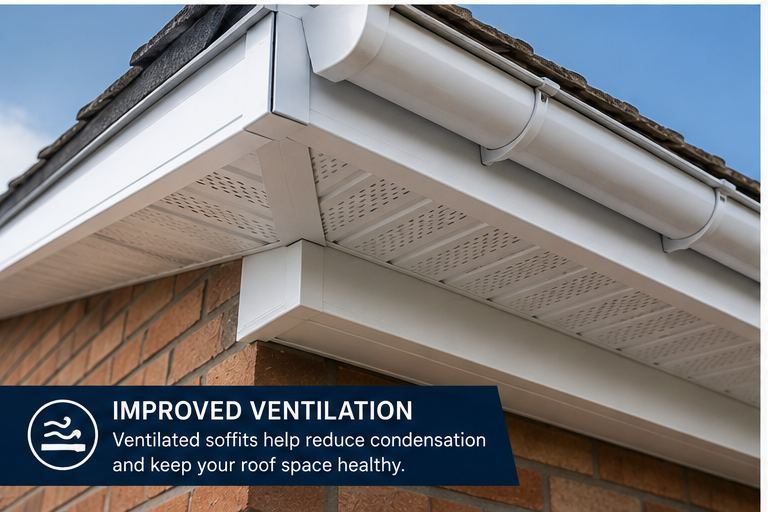
UPVC is very low maintenance and is cleaned rather than painted. In streets where scaffold blocks the pavement and yards are small, avoiding repeat access is a real benefit. Boards come in white and darker or wood-effect finishes, and vented soffits can be fitted so the roof space breathes.
Replacement is also a chance to check the rafter ends and eaves properly, which is hard to do when the boards are left in place. Anything found, such as damp rafter ends or gaps where birds get in, can be dealt with before the new boards are fixed.
What we check first
Before replacing anything, we see whether repair is enough. If rot is limited and the rest is firm, we say so. On older homes, we check what the existing soffit boards are made of before disturbing them. If replacement is better, we explain why and set out the work in writing, including how scaffold and gutters will be handled.
Frequently Asked Questions
Is it better to replace the fascia or just repair it?
A short length of rot can often be repaired. When damage is widespread, paint will not hold or gutters will not stay fixed, renewing the boards is the better route. We look and tell you which applies.
Can I choose a colour other than white?
Yes. Boards are available in white, darker shades and wood-effect finishes. The colour is part of the board, so it does not need painting. We suggest looking at samples against your brickwork and window frames before deciding.
Will replacing fascias affect my neighbours?
Terraces share a roof edge, so we let neighbours know when access is going up. If the work meets a shared fascia run, we agree how to finish neatly at the party wall, so the line looks tidy from the street.
Talk to our team about UPVC fascias and soffits in Redfield
Every roof is different — the fastest way to get an accurate answer is a quick chat with our team.