
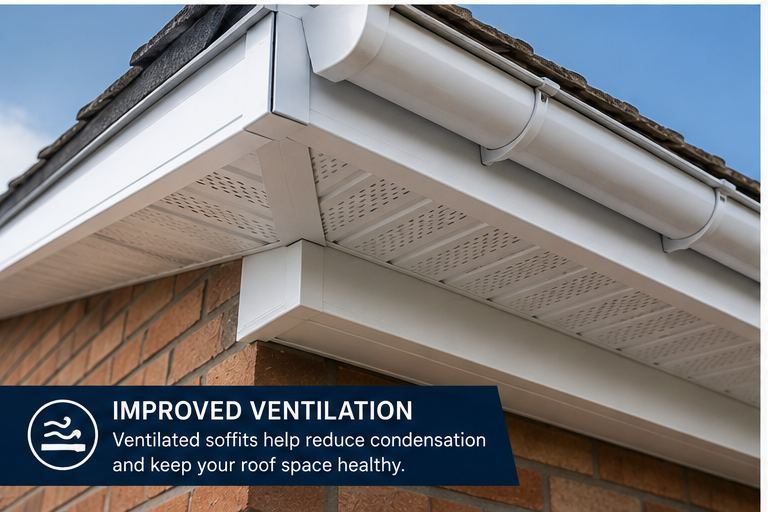
Soffit vents let air flow through the roof space so moisture does not build up. On older terraced houses, that airflow helps protect the roof timbers that hold everything up.
The soffit is the board that closes the underside of the eaves. On a roof that needs ventilation it is also where air gets in. In Kingsdown, with tall Georgian and Victorian terraces and steep roofs, the roof space is deep and the timbers old, so keeping it dry matters.
The job the vents do
Damp air from bathrooms, kitchens and everyday living rises into the roof space. If it cannot escape, it condenses on cold timber and felt and stays there. Vents at the eaves let in cooler, drier air, which moves up through the roof and out again, carrying the moisture away. Cooking, bathing and drying washing indoors all send moisture upwards, and tall houses carry it a long way up to the loft.
Signs of poor airflow
A roof space without enough ventilation may show damp timbers, dark mould patches, condensation on the underside of the felt and a musty smell. These can look like a leak but are not, and fixing them is a ventilation matter, not a roof repair. Over time, damp can weaken old rafters and spoil ceilings below. Moisture can also drip from nails in the timbers on cold mornings, which people often mistake for a slow leak.
What we fit
When replacing soffits, we fit vented soffit boards or add vent strips along the eaves so air can pass in. The openings are small and covered, so they do not invite birds or insects. We choose between them based on how the eaves are built. We also check that loft insulation has not been pushed into the eaves and blocked the gap.
- Vented soffit boards fitted at the eaves
- Vent strips set into a gap behind the fascia
- Insulation kept clear of the airflow
- Rafter ends and eaves inspected before new boards go on
Old houses and what is behind the boards
On older homes, we check what the existing soffit boards are made of before we disturb them, and we handle them with care. Behind them, rafter ends and wall plates can have suffered from years of damp. Fresh air only helps if the timber that it protects is sound. In houses that have been altered over time, previous owners may have blocked old gaps, so we check what airflow actually exists.
Access and finish
Work at the eaves of tall terraces needs a scaffold or tower. Old boards and gutters come off, the eaves are checked, new fascias and vented soffits go on, and the gutters are refitted or replaced. UPVC is very low maintenance and comes in white, darker and wood-effect finishes. We tell you which style suits the house. New boards also give the roof edge a clean, even line along the whole terrace frontage.
Frequently Asked Questions
Will vents make my house colder?
The vents serve the roof space above the insulation, not your living rooms. They keep the loft dry and do not draw heat from the rooms below as long as the insulation is in place. If in doubt, ask us and we will explain what we find.
Can I add vents without replacing the soffits?
Sometimes. If the boards are sound, vent strips or discs can be added. On old or damaged boards, replacing them is often neater and lets us check the eaves behind at the same time. If in doubt, ask us and we will explain what we find.
What if my soffits are solid and the loft is dry?
A dry loft is a good sign, but solid soffits can still limit airflow in the long run. We look at the whole roof space, not just the boards, and tell you whether extra ventilation is worth adding.
Talk to our team about UPVC fascias and soffits in Kingsdown
Every roof is different — the fastest way to get an accurate answer is a quick chat with our team.