
Most roof window leaks are not the glass. Flashing, sealing, condensation and the roof covering around the frame cause far more of them, and each needs a different fix.
A drip below a VELUX or similar roof window sends most people straight to blame the window. In practice the glass is rarely at fault. The leak usually comes from what surrounds it, or from moisture forming inside the room. Working out which is the first job, because the repairs are quite different.
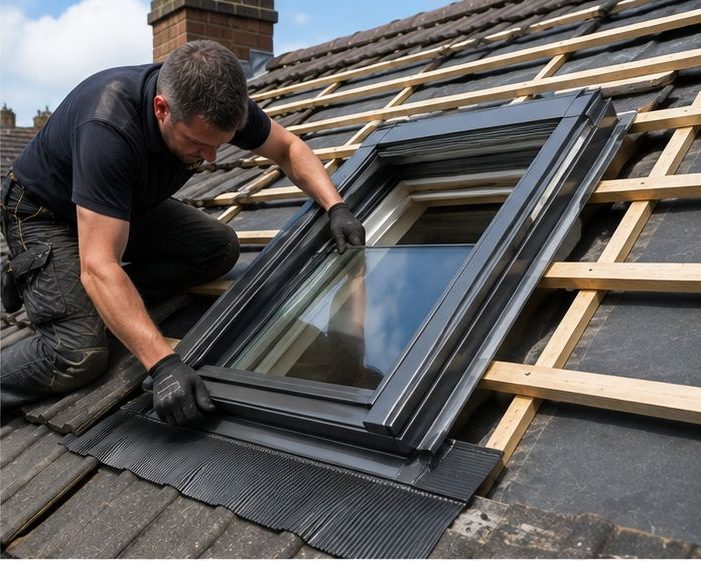
Flashing that has failed
The flashing kit sealing the window into the roof covering is the most common culprit. If it was not matched to the tiles or slates, was fitted badly, or has been disturbed by moving tiles or lead, water gets behind it. Corners and the lower edge are where it gives way first. A repair may be a re-dress or a full re-fit. A leak that appears only in strong wind often points to the flashing corners.
Seals and the frame
Rubber seals harden and the outer frame covering can loosen with age. A gap lets driven rain through, especially in a gale. These parts can sometimes be replaced without changing the whole window. We check whether the sashes close tightly and whether the frame has shifted in the opening, which is common on older installations. Old windows sometimes sit slightly out of square, which opens a gap at the seal.
- Seals that are hard, cracked or flattened
- Frame sitting unevenly in the opening
- Sash not closing flush all round
- Rust or staining on the outer cover
Condensation that looks like a leak
Water running down the glass or pooling at the sill is often condensation, not rain. Warm, damp air in the room meets cold glass. Poor lining, missing vapour control or inadequate insulation round the opening makes it worse. If the pane is misted between the layers, that means the sealed unit has failed. Black spots or mould on the lining are another sign of condensation.
The roof covering around the window
Sometimes the window is fine and the surrounding tiles or slates have slipped, cracked or lifted, letting water run into the opening from above. The felt beneath may be damaged. We examine the covering above and beside the window, as well as the window itself, before saying where the water is getting in. The felt around the opening is lifted and checked wherever we suspect it.
What we do about it
We trace the leak from the room, through the loft and out to the roof, then explain what we found. The fix may be new flashing, new seals, renewed lining and insulation, repairs to the covering, or a replacement window. Whichever it is, you get the findings and the scope written down. If the cause is the covering, that is repaired and the window left in place.
Frequently Asked Questions
Does a leaking window always need replacing?
No. Many leaks are cured by replacing flashing, seals or the covering around the frame. Replacement is for failed sealed units, damaged frames or old windows past repair. We tell you which applies.
How do I tell condensation from a leak?
Condensation appears on the glass and frame, usually on cold mornings, and often disappears as the room warms. A leak appears during or after rain and drips from the frame or surround. We check both.
Should I seal it with silicone myself?
Please do not. Silicone on the outside of a frame or flashing can trap water and hide the cause. It also means going on the roof, which we advise against. Call us and we will find the actual source.
Talk to our team about VELUX and roof window installation in Eastville
Every roof is different — the fastest way to get an accurate answer is a quick chat with our team.