
Most leaks around a roof window are not caused by the glass. They come from flashing, seals, condensation or the roof around it. Here is how we work out which, in Portishead conditions.
A drip beside a roof window sends most people straight to blame the glass. In practice the glass is seldom the culprit. Coastal rain, strong gusts and the way the window was fitted all play a part. Finding the true cause saves replacing something that was never faulty.
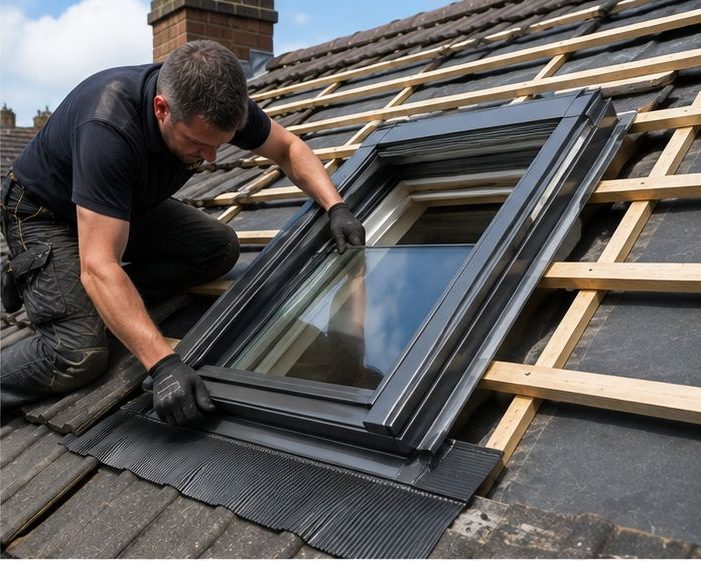
The flashing is the usual suspect
Every roof window sits in a flashing kit that shapes water around the frame and onto the roof covering. If the flashing has lifted, been fitted badly, or no longer suits the tiles or slates around it, rain gets behind. This is the most common cause of leaks on roof windows.
We look at how the flashing laps over the tiles, because the order matters. Water should always run over the next piece and never underneath it, and a kit fitted in the wrong order will leak however well it looks from the room below.
Seals and the frame
The rubber and sealing around the sash age and can shrink or split, letting wind-driven rain in at the corners. A window not fully closed, or one that was knocked out of alignment, can do the same. In exposed spots, repeated gusts test every join.
Wind-driven rain is a real test of these seals. A window that stays dry in ordinary showers can still let water in at a corner when a gust pushes a sheet of rain straight at the frame, so note whether it happens only in storms.
- Hardened or split seals around the sash
- A frame out of square so the sash does not close
- Flashing corners lifted or poorly lapped
- Gaps in the roof covering just above the window
Condensation and misting
Water running down the inside is not always a leak. Warm, damp air meeting cold glass leaves droplets, and poor ventilation in a loft room makes it worse. Misting between the panes, though, means the sealed unit has failed and the glass unit needs replacing. Neither is fixed by sealant.
The roof around the window
Sometimes the window is fine and the surrounding tiles are slipped, cracked or poorly cut in. Water then runs down to the frame and appears to come from it. Without lining, insulation and vapour control done properly around the opening, damp can also collect inside and mimic a leak.
How we find and fix it
We check the room side for the pattern of staining, then inspect the window, the flashing and the covering around it. The cure may be a refixed flashing, new seals, a replaced glazing unit, or a new window set properly. We explain which, and why, in plain words.
If the window itself is old, repair may not be sensible, and replacing it with a correctly flashed unit saves chasing the problem. We tell you which route we think is right, and why, before any work is booked in.
Frequently Asked Questions
Is my VELUX window leaking or just condensing?
Condensation shows as fine droplets on the glass, often on cold mornings. A leak leaves staining or a drip from the frame or lining. If you are unsure, note when it happens and tell us.
Can sealant on the outside stop the leak?
Sealant on its own rarely lasts and can hide the real cause. The fix is usually to correct the flashing or the covering around the window. We would explain what is actually failing first.
Will you need to remove the whole window?
Not always. Many leaks are put right by refitting or replacing the flashing or the seals. If the frame is damaged or the window is old and misting, replacement may make more sense.
Talk to our team about VELUX and roof window installation in Portishead
Every roof is different — the fastest way to get an accurate answer is a quick chat with our team.