
Most roof window leaks are not the glass. They come from the flashing, the seals, condensation or the roof covering around the frame. Here is how we tell which.
A damp patch under a roof window in a Sneyd Park loft is worrying, particularly in a tall villa where the window sits well up the slope. The glass itself is rarely to blame. VELUX and similar roof windows leak because of what surrounds the glass, and finding the true cause matters before anyone reaches for sealant.
Is it really a leak
Condensation is often mistaken for a leak. Warm, damp indoor air meets a cold pane or frame and runs down as droplets, wetting the lining below. If the water appears on dry, still days, or mostly overnight and in the morning, condensation is likely. Genuine leaks tend to follow rain, and wind-driven rain makes them worse.
Flashing and sealing faults
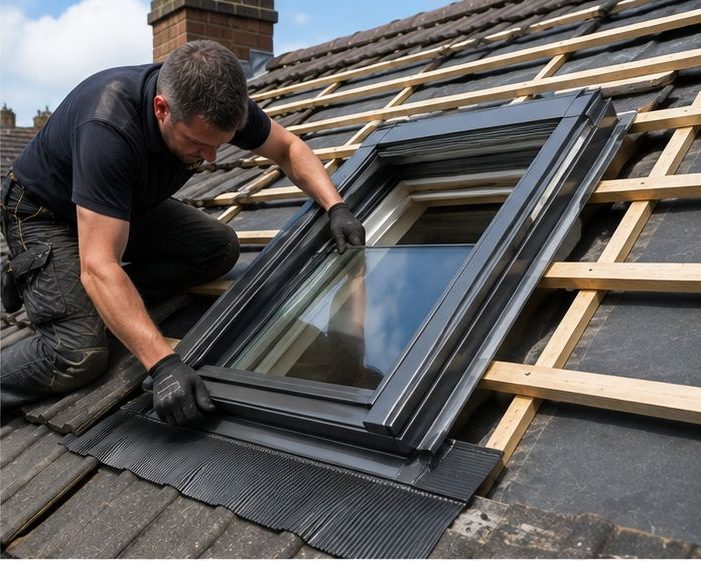
Each window has a flashing kit that seals it into the roof covering, matched to that covering. If the kit is the wrong type, fitted badly or has been disturbed, water gets under it. Seals around the sash age and harden too. Water entering at the top or sides often travels along the frame before showing inside.
- Wrong or poorly fitted flashing kit for the covering
- Hardened or split seals around the sash
- Lining and insulation that is stained or damp
- Water marks following rainy, windy days
The roof around the window
Slipped slates, cracked tiles or tired felt near the window can send water into the opening from above. On large villa roofs with many valleys and chimneys, the leak may start somewhere else and simply show up at the window. We look at the surrounding roof as well as the frame before deciding.
Misting and failed glass
If moisture appears between the panes and will not wipe away, the sealed unit has failed. That is a glass fault rather than a roof leak, and the unit or the window can be replaced. It is common on older windows, and it does not mean water is coming through the roof itself.
Mature trees nearby can leave debris collecting above and at the sides of the frame, so we check that water can run clear and is not backing up against the flashing, which would make a sound window leak in heavy rain, and we clear what we can reach safely.
What we do
We inspect from inside, looking at the lining, insulation and vapour control around the opening, then check the flashing and covering outside. Repairs range from renewing seals to refitting the flashing kit or replacing the window altogether. Ask for an explanation of what was found, not simply an application of sealant.
Where the window is old and the lining is stained, we say whether the whole unit should be replaced, because patching a tired frame in a tall roof means returning with access a second time, which is a poor use of your money and our time.
Frequently Asked Questions
Can sealant fix a leaking roof window?
Rarely, and not for long. Sealant over a badly fitted or damaged flashing hides the symptom for a short while but water finds another way in. We look for the real cause first, then repair that properly.
Why does my roof window drip with no rain?
That is usually condensation. Warm, moist air meeting a cold surface forms water droplets. Better ventilation and sound insulation and vapour control around the frame help, and we check these when we look at the window.
When is a new window better than a repair?
When the frame is distorted, the sealed unit has failed, or the flashing cannot be put right. We explain what is wrong, what a repair would achieve, and whether replacement makes more sense for the room.
Talk to our team about VELUX and roof window installation in Sneyd Park
Every roof is different — the fastest way to get an accurate answer is a quick chat with our team.