
On older houses a dry verge can often replace failing mortar, but only when the tile profile, the edge and the timbers allow it. We check each of those first.
Many roofs in Filton are decades old, and where there is a gable, the mortar verge is often the first thing to fail. Swapping it for a dry system is a well-known repair, but not every older roof will take it. The question is what is under the mortar and whether the units can be fixed securely.
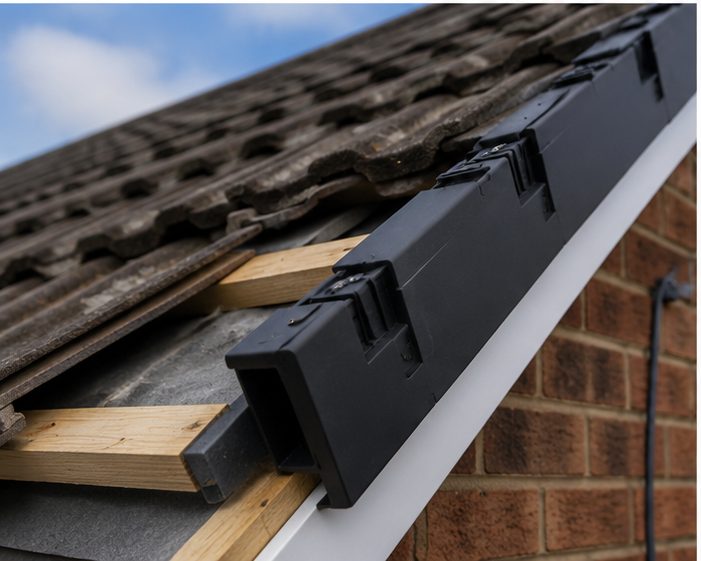
Why older roofs ask the question
Mortar on a gable edge cracks with frost and wind movement, then drops onto paths and drives. On inter-war and post-war houses the mortar has often been patched more than once. Replacing it with a mechanical system is a way to end that cycle, if the roof can take the new units. On a long hipped roof with a gable at one end, that edge is often the only wet-mortar detail left.
What we check first
Tile profile comes first, because the verge units are made for particular shapes. Older tiles may be slightly different in size or thickness from modern ones, and we need to confirm a match on site. We then look at the end tiles, the battens at the edge and the overhang at the gable. Older tiles can differ slightly in size from modern ones, so a unit that looks right on paper may not sit well.
- Tile profile and size compatible with the units
- End tiles sound, not cracked or loose
- Edge battens firm and not rotten
- Enough overhang for the units to sit properly
Dealing with what is underneath
Removing old mortar shows what the edge is really like. We sometimes find underlay that is torn, cracked tiles hidden by mortar or timber that has gone soft where damp got in. These are repaired first so the new units sit on a sound base. Fitting units over a bad edge only covers the problem. Any timber that has gone soft is cut out and replaced with sound material.
How the work is done
The mortar is removed and the edge cleaned back. Damaged tiles are replaced, the underlay is dressed at the edge, and the units are fixed with the right fixings to the tile maker's guidance. Tile-end and cap pieces complete the run. The finished edge needs no wet mortar and sheds water by design. Fixing to the maker's guidance means the right fixing type and spacing for the tile.
When it is not the right answer
If tiles are failing across the roof, a new verge alone will not stop leaks. If the units do not suit the tile, we say so and discuss alternatives. A dry verge is a good repair for a failed edge, not a cure for every fault. We will tell you which problem to deal with first.
Frequently Asked Questions
Do older tiles accept dry verge units?
Sometimes. It depends on the tile shape and size. We check on site, and if there is no compatible unit we explain what other options exist for the edge. Sometimes a unit made for a similar tile can be adapted, but only if it sits securely.
Will the roof need re-tiling to fit a dry verge?
Usually not. Most fitting involves the edge tiles only. If the end tiles are damaged or the battens are poor, those are repaired. We tell you what is needed before work begins. Replacing a few damaged tiles at the edge does not mean re-roofing.
How do I know the mortar has failed?
Loose or fallen mortar, cracks along the edge, gaps at the gable and debris on the drive are the usual signs. Please look from the ground and call us rather than going up.
Talk to our team about dry verge systems in Filton
Every roof is different — the fastest way to get an accurate answer is a quick chat with our team.