
Heavy rain exposes faults a light shower never reaches. On Filton's hipped roofs the entry point is often at a hip, a valley or a chimney, well away from the stain.
A leak that appears only in a downpour tends to come from a defect that stays dry in ordinary weather. In Filton, many homes have hipped roofs with several junctions where water can get in, and older roofs with tired fixings and felt. Here is how heavy rain finds those faults and how we follow the water back.
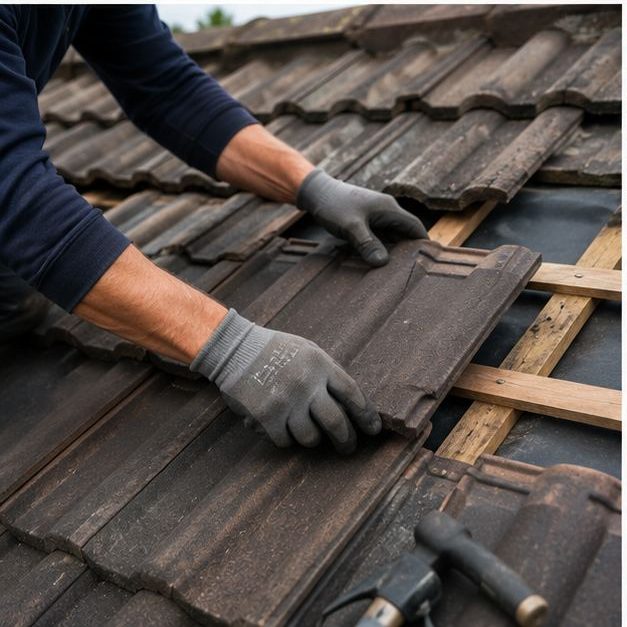
Why heavy rain finds the weak spot
In a downpour the roof sheds a large volume of water quickly, and wind pushes it sideways under laps and into gaps. A lifted tile, a lead edge that has curled or a worn bedding joint can pass little water at other times and a lot in a storm. Gutters that cannot cope make it worse by backing water under the edge. Wide streets give wind a clear run across hipped roofs, so edges and corners take the worst.
Hips, valleys and junctions
A hipped roof has more joints than a simple gable. Hip tiles, valley gutters and the points where hips meet the ridge are all places where water can pass if the bedding or lead has failed. Chimneys add another junction, with lead flashings that crack or lift. Extensions and porches add yet more.
- Hip tiles loose or with failed bedding
- Valley gutters blocked or with worn lining
- Chimney flashings lifting from the brickwork
- Roof-to-wall junctions at extensions and porches
Water travels before it shows
The stain on the ceiling is where water reached a place it could drop, not where it came in. It can run down felt and along rafters for a long way. We treat a stain as the end of the trail and work back up the slope to find the start, checking the loft for damp timbers on the way.
Old roofs and tired felt
Older inter-war and post-war roofs often rely on underlay that is worn, torn or missing in places. When tiles shift, that layer is the last defence, and it may no longer hold. A roof can look fine from the street yet admit water in heavy rain through felt that has simply aged. Torn or perished felt may not show from outside, but a loft check reveals daylight and damp patches.
What to do now
Catch drips, move belongings and keep water away from electrics. Check the loft with a torch when it is dry and note any daylight or damp. Please do not go onto the roof or use a ladder against it. Photographs help, and a proper look from us tells you what is urgent and what can wait. We then talk through repair options.
Frequently Asked Questions
Why does my ceiling only leak in the worst storms?
Because the defect only lets water in when volume or wind pushes it through. In light rain the water runs off. The fault is still there, so it makes sense to have it traced before the next heavy spell. The damage rarely stays the same.
Could the leak be from the gutter rather than the roof?
Yes. Blocked or leaking gutters can send water back under the edge tiles and into the eaves. We check the gutters and the roof edge as part of tracing any leak. Tracing it in dry weather is easier, and the loft shows where water has been.
Is it worth waiting until the weather improves?
The roof is usually easier to assess in dry weather, but leaving a leak lets damp spread into insulation and timbers. We can look at the cause and advise on what needs doing straight away and what can wait.
Talk to our team about roof repairs in Filton
Every roof is different — the fastest way to get an accurate answer is a quick chat with our team.