
Fascia, soffit and gutter are three different parts of the same roof edge. Each does its own job, and telling them apart helps you describe what is wrong.
People often use the words fascia, soffit and gutter as if they meant the same thing. On the hipped roofs common across Filton, the eaves go right round the house, so all three parts are on show. Here is what each one is, what it does and what goes wrong with it.
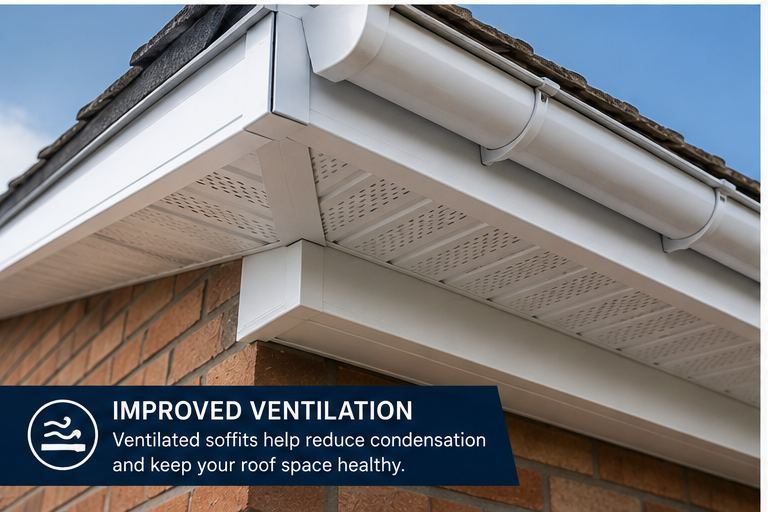
Fascia: the face of the roof edge
The fascia is the board fixed to the ends of the rafters, running along the bottom of the roof. It carries the gutter and closes the gap behind it. On a hipped roof it runs round all four sides, with corner joints at each turn. Where timber fascias have been wet for long, they soften, split and let the gutter sag. A sound fascia is the foundation of the whole edge.
Soffit: the underside of the eaves
The soffit closes the underside of the eaves, between the back of the fascia and the wall. It keeps out birds, insects and weather, and in newer work includes vents so air flows into the roof space. Problems show as sagging panels, holes, peeling paint on timber or dark staining where damp has got in. Because the soffit is out of sight, faults go unnoticed for a long time.
Guttering: the water channel
The gutter collects rain from the roof and carries it to the downpipes. It is fixed to the fascia by brackets, and set to a gentle fall. Leaks at joints, sagging sections and overflowing corners are the typical faults, along with blockages from leaves and moss. Overflowing water running down the wall can mark brickwork and soak the eaves. We check the fall of the run as well as the joints.
- Overflow at corners and joints
- Sagging sections between the brackets
- Water marks on walls below
- Moss or plants growing in the channel
Bargeboards and where they sit
On a gable the board along the sloping edge is the bargeboard. It does the same job as a fascia but at the roof end. Hips have none, since the roof turns the corner. Many Filton houses, being hipped, have mostly fascias, with bargeboards only where there is a gable. If a gable has been boxed in or altered, we check how the board meets the fascia.
Why it matters when you have a problem
A leaking gutter can rot the fascia. A cracked soffit can let in damp and vermin. A fascia that has failed can leave the gutter hanging. Knowing which part is at fault helps you describe it, compare quotes and avoid paying for work that you do not need. We explain what we find. A quick look from the ground often tells us which part to focus on.
Frequently Asked Questions
Which part holds the gutter up?
The fascia. The gutter brackets fix to it, so the board must be sound and well fixed. If the board is soft or loose, the brackets will not hold and the gutter will sag.
Can I replace just the soffit?
Yes, if the fascia and gutters are fine. Soffit boards can be replaced separately, though this often involves removing the gutter or at least working around it. We advise on the most sensible approach.
What does vented mean for a soffit?
A vented soffit has slots or a strip that lets air into the roof space. This helps prevent condensation and keeps timbers dry. We fit vented soffits or vent strips when we replace boards.
Talk to our team about UPVC fascias and soffits in Filton
Every roof is different — the fastest way to get an accurate answer is a quick chat with our team.