
Usually yes, provided the tile profile suits the units and the edge is sound. Garages, semis and short terraces all come up, and each needs checking on site.
Owners in Hillfields often notice mortar dropping from the gable edge of a semi, a short terrace end or a garage, and ask whether a dry verge can be added without re-roofing. In many cases it can. The answer depends on the tiles, the edge timbers and the state of the roof beyond, and we explain each below.
What makes it possible
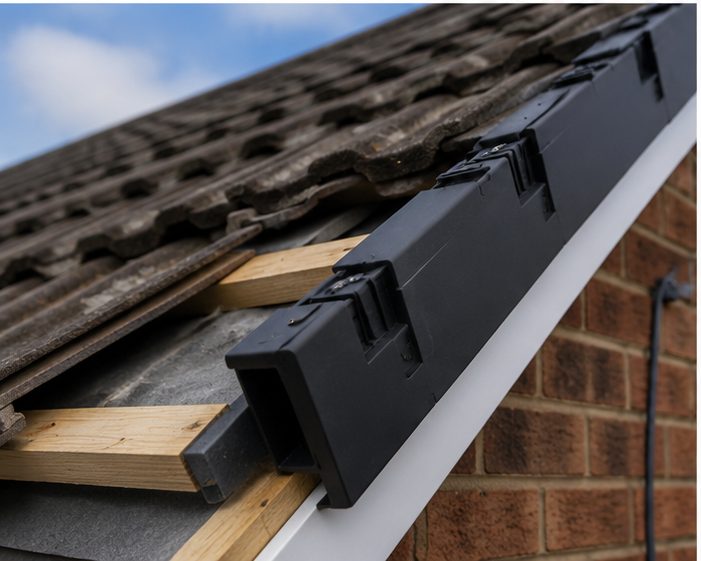
A dry verge fixes to the roof at its edge, so the rest of the covering can stay as it is, if it is sound. What matters is whether suitable verge units exist for your tile profile, and whether the batten ends, rafters and underlay at the edge can take the fixings. We confirm both with a look on site. That is why the look-over on site always comes before any promise.
Inter-war and post-war tiles
Roofs of these eras are often covered in concrete interlocking tiles or plain tiles, and some have had repairs with different types over the years. Each profile has its own matching unit, and some older shapes have no direct equivalent. We compare units against your tiles before saying yes. Where a close fit is not possible, we explain the options plainly rather than force something that will not sit right.
- Concrete interlocking profiles that suit factory verge units
- Plain tiles of various sizes
- Mixed tiles from earlier repairs
- Slopes with worn or cracked end tiles
The edge itself
Before fitting, we inspect the edge for rotten barge boards, soft battens, perished felt and tiles that are loose. Any weak parts are put right first, because screws and clips need sound timber to hold. On garage roofs with a low gable, access is easier but the same checks apply. Semis and end-of-terrace gables get the same treatment as a garage.
How it goes on
We clear the old mortar and loose pieces, then fit verge units and tile-end pieces to the maker's guidance, with cap and ridge-end pieces to finish. Cracked tiles at the edge are replaced. The result is a mechanically held edge with no wet mortar. Where work may need planning or Building Regulations checks, we advise before work starts. Taking time over the clean-up keeps debris off your drive and path.
When to hold off
If the roof is failing across the slope, with slipped tiles, tired felt or rotten battens, a dry verge is not the first job. We will tell you what is urgent and what can wait, and whether fitting the verge now still makes sense or whether it belongs in a wider repair. Being straight about this saves you paying for the wrong job first.
Frequently Asked Questions
Can a dry verge go on a garage roof?
Yes, if the garage roof has a gable edge and the tiles suit the units. Garage roofs are usually simple to access, but we still check the edge timbers and fixings before we agree to fit.
What if only part of the verge has failed?
We usually advise doing the whole edge so it is consistent and mechanically fixed throughout. Mixing mortar and dry units on the same gable can leave weak points and an uneven look. It also avoids water finding the join.
Is mortar still needed anywhere?
Not at the verge. A few other details on a roof may still use mortar, such as some hips or chimney work, and we explain what is used where when we describe the job.
Talk to our team about dry verge systems in Hillfields
Every roof is different — the fastest way to get an accurate answer is a quick chat with our team.