
Each part of the roofline does a separate job. Here is a plain guide to which board is which on the semis, terraces and garages of Hillfields.
Talk to three roofers and you may hear fascia, soffit, bargeboard and gutter used loosely. They are different parts. On a typical Hillfields semi, short terrace or garage, they sit together at the roof edge, and a fault in one often damages the others. This guide sets out what each does and what to watch for from the ground.
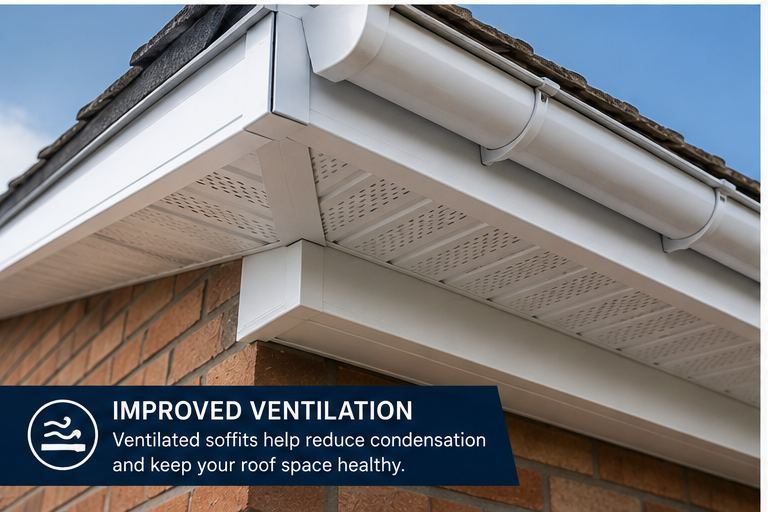
Fascia
The fascia is the long board you see running across the front of the eaves, fixed to the ends of the rafters. It carries the gutter and gives the roof a clean edge. Timber fascias on older homes can rot where water sits, while UPVC ones are cleaned rather than painted. On a hillside, wind-driven rain makes a sound fascia even more valuable.
Soffit
The soffit is the board fitted underneath the overhang, closing the gap between the wall and the fascia. Look up from the garden and you will see it. It keeps birds and insects out of the roof, and when vented it lets air flow into the roof space so the timbers stay dry.
- Closes the underside of the roof overhang
- Hides rafter ends from view
- Vented boards or strips let the roof breathe
- Sagging or gaps let nesting animals in
Bargeboard and guttering
A bargeboard is the board along a gable edge, where the roof ends at the side wall. Guttering is the channel fixed to the fascia, catching rain and carrying it to the downpipe. On garages and lean-tos, a single gutter run may serve a long, low roof, so a blockage tends to overflow onto the boards below. Each of these is easy to spot once you know the names.
Warning signs from the ground
Look for peeling or dark patches on boards, gutter joints that drip, green staining on the wall below, sagging gutters and soffits with gaps. After rain, watch where water runs. If it spills over the front of the gutter or down the wall, something is blocked or loose. Please do not use a ladder or climb up. Photograph what you see and ask us to take a proper look.
- Gutter overflowing in an ordinary shower
- Boards soft, cracked or flaking
- Soffit sagging or missing or missing in places
- Downpipes loose or leaking at joints
When they are replaced together
If one part fails because of another, such as a leaking gutter rotting a fascia, we usually advise doing all three at once. That means scaffold, removal of old boards and gutters, a check of rafter ends and eaves, new boards with vented soffits or vent strips, and new gutters. Where work may need planning or Building Regulations checks, we advise before work starts. A clear written list keeps the work easy to compare.
Frequently Asked Questions
Is a fascia the same as a soffit?
No. The fascia is the vertical board at the front of the eaves carrying the gutter, while the soffit is the horizontal board closing the underside. Both can be UPVC and are normally replaced together.
Why do my gutters keep overflowing?
Most often because they are blocked with leaves, moss or debris, or because they have dropped out of level. A gutter that has lost its fall holds water and spills. We check the fall and the fixings, not only clear it.
Can I replace only the damaged fascia board?
Sometimes, if the rest is sound and a match is available. If the damage is spread, or gutters and soffits are also tired, replacing the whole run saves repeat visits and gives a neater result.
Talk to our team about UPVC fascias and soffits in Hillfields
Every roof is different — the fastest way to get an accurate answer is a quick chat with our team.