
A roof that stays dry in a shower but drips in a downpour has a weak spot that only fails when water arrives hard and fast. Here is how to think about it.
Plenty of leaks never show in light rain. In Hillfields, with its inter-war and post-war semis, short terraces and garages on a hill, heavy rain tends to arrive sideways and in volume, and any weakness in the covering is tested. The sections below explain where the water usually gets in, what you can safely check, and how we find the cause.
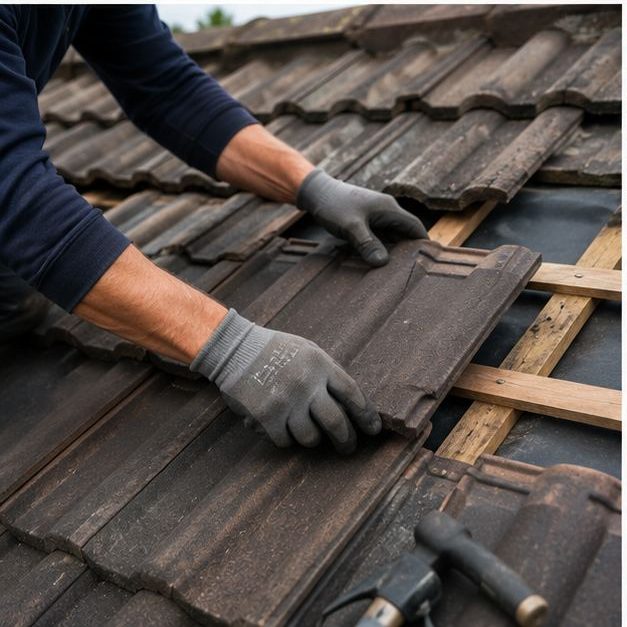
Why a downpour finds the weakness
A small defect can cope with a normal shower. In a downpour the roof sheds more water than the gap can handle, and wind drives it up under tile laps and into the felt. Water then follows timbers sideways before dripping, so the mark inside is seldom directly below the way in. Tiles at the very top of a hill can see it first.
Likely entry points on these houses
On semis and terraces the usual suspects are slipped or cracked tiles, worn ridge and hip bedding, lead flashing at chimneys and party walls, and short valley gutters where roofs meet. Garage roofs and lean-to sections have their own junctions with the house wall. Hill exposure matters. Rain from the open side of the slope pushes into gaps that stay dry on sheltered roofs, so leaks often show on one particular face.
- Cracked or slipped tiles on the windward slope
- Ridge and hip mortar that has broken up
- Chimney or party wall flashing lifting
- Valleys and gutters that cannot clear the flow
What to look at indoors
In the loft, check for daylight, wet or dark patches on rafters, stained felt and damp insulation. Look at upstairs ceilings and the corners of rooms under the affected slope. Put a bowl under any drip, move belongings, and note when it starts and stops. These notes help us work out the route water takes. A phone photo of the stain beside a tape measure is useful too.
How we trace the source
We start from the stain and work up and across, because water travels. We check tiles, ridge, flashings, valleys and gutters from safe access, and then confirm in the loft. The aim is to find the real entry point, not just seal the nearest spot. We then explain whether a repair will hold or the slope is wearing out. Where needed, we check the neighbouring slope too.
What to ask and what to avoid
Ask what was found, where, and whether it is a patch or a lasting repair. Avoid anyone proposing to coat the whole roof without finding the cause. Do not go on the roof yourself or try to clear it. Where work may need planning or Building Regulations checks, we advise before work starts. Plain, specific answers matter more than a confident manner.
Frequently Asked Questions
Why does the stain not match where the roof is damaged?
Water runs along felt, battens and rafters before it drips. By the time it appears on the ceiling it may be a metre or more from the entry point. Tracing it means following the path back up the slope.
Is a heavy-rain leak less serious than a constant drip?
Not necessarily. Intermittent leaks soak timbers and insulation repeatedly, and the damage builds quietly. It is better to fix the cause before the next storm than to wait for a leak that is easier to see.
Can I stop it myself with sealant?
Sealant on a roof is a short-term guess and means working at height, which we do not recommend. Take photos and note when it leaks, then call us so the real source is found and repaired.
Talk to our team about roof repairs in Hillfields
Every roof is different — the fastest way to get an accurate answer is a quick chat with our team.