
The roof edge takes the worst of a gale. This guide explains how a dry verge resists wind at the gable, where it helps and where it cannot save a roof that is failing elsewhere.
Wind gets under tiles at the edge first, because the edge is where air is forced up and over the roof. A mortar verge has little to hold it once it cracks. A dry verge fixes the edge mechanically, which gives the outer tiles a firmer hold in the gusts that tall Bishopston houses catch.
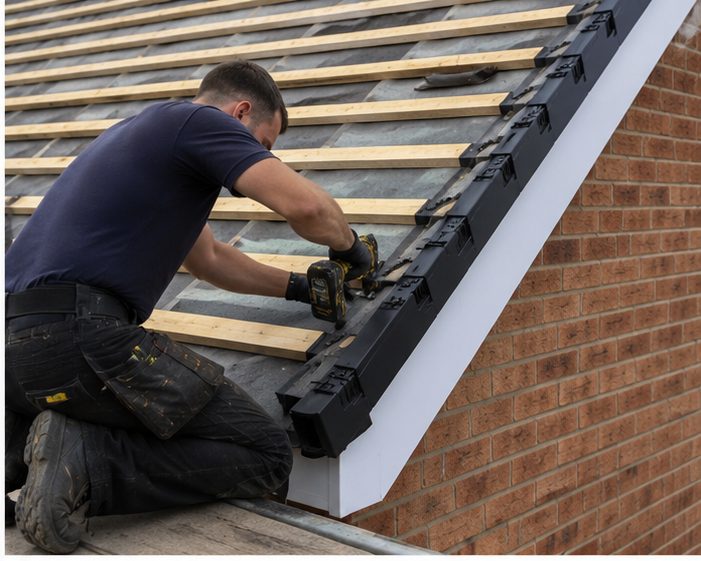
Why the edge is the weak point
At a gable, wind pushes against the wall, rushes over the top and tries to lift the outer tiles. Uplift is strongest at the verge. If the mortar bedding has cracked or loosened, the edge tiles can shift or lift, and one loose tile can lead to others. That is why storm damage so often starts at the edge. A fixed edge also looks neater and tidier from the street.
How a dry verge resists the wind
The verge units are fixed through to the roof structure and hold the edge tiles down along their length. There is no wet mortar to fail, so there is no joint to crack and let go. The tile-end and cap pieces are fixed as well, giving a continuous restraint along the whole edge, in line with the tile maker's guidance.
- Edge tiles are held down with fixings.
- No mortar joint to crack or fall.
- Caps and tile-ends are fixed, not just bedded.
- Cleaner line with fewer loose pieces.
What it cannot do
A dry verge is not a cure for a roof that is failing elsewhere. If tiles are slipped across the field, felt is perished or battens are weak, the verge will not rescue it. It also depends on the tile profile, so compatibility is checked on site. We tell you honestly if the better answer is a wider repair. A sound base matters first.
Signs your verge is struggling
Look from the ground for mortar on the path or drive, tiles at the gable edge that sit out of line, or gaps visible against the sky. After a blustery spell, check for debris. Do not climb up to look. These signs are the cue to call us, so we can see whether the edge needs a repair or a dry verge.
- Crumbs or lumps of mortar below the gable.
- Edge tiles out of line.
- Gaps at the roof edge against the sky.
- Loose pieces after a storm.
Planning the work
A dry verge can go on at a re-roof, as part of a repair where mortar has failed, or on a new roof. We look at the tile type, the condition of the battens underneath and how the edge is built. Scaffold or safe access is arranged. We explain each step so you know what is fixed and why.
Frequently Asked Questions
Does a dry verge make the whole roof storm-proof?
No. It strengthens the edge, which is where wind often attacks first, but the rest of the roof still matters. Tiles, felt and fixings all need to be sound for the roof to cope with a storm. That is why we check the structure first.
Is a dry verge better than mortar in wind?
For wind resistance at the edge, a mechanically fixed system generally does better, because it does not rely on brittle mortar. Mortar can still be done well, but it will need repair as it ages.
Can it be fitted to any tile?
Not always. The verge units need to suit the tile profile, and that is checked on site against the maker's guidance. If a dry verge is not suitable, we explain the alternatives. We check the tile type first.
Talk to our team about dry verge systems in Bishopston
Every roof is different — the fastest way to get an accurate answer is a quick chat with our team.