
The roof edge at a gable takes the worst of a gale. A dry verge fixes the edge tiles mechanically, giving the wind less to grab hold of, though it cannot repair a roof that is failing elsewhere.
Frenchay's roofs range from older stone cottages to modern estate houses, and gables on each face the weather from the side. Wind gets under the edge tiles and tries to lift them. Understanding how a dry verge helps, and where its limits lie, helps you decide if it suits your house.
Why the gable edge is exposed
At a verge the tiles stop and the wall begins, so wind can reach the underside of the last tiles from the side. It lifts them, shakes the mortar and works any loose piece free. Of all places on a roof, the verge is where storm damage most often begins.
Houses near the Frome valley and the common can sit more openly to the wind than those tucked in among others, so a gable facing the weather may take more than its neighbours. Wind exposure varies house to house, which is why the edge is inspected individually.
What holds a traditional verge
A mortar verge relies on a bed of mortar to seal and hold the edge. Mortar is brittle and shrinks, and fine cracks let rain in. Over time it loosens, and a gust can pull sections away. Once the edge has gone, the next tile in is the next to go.
How a dry verge changes this
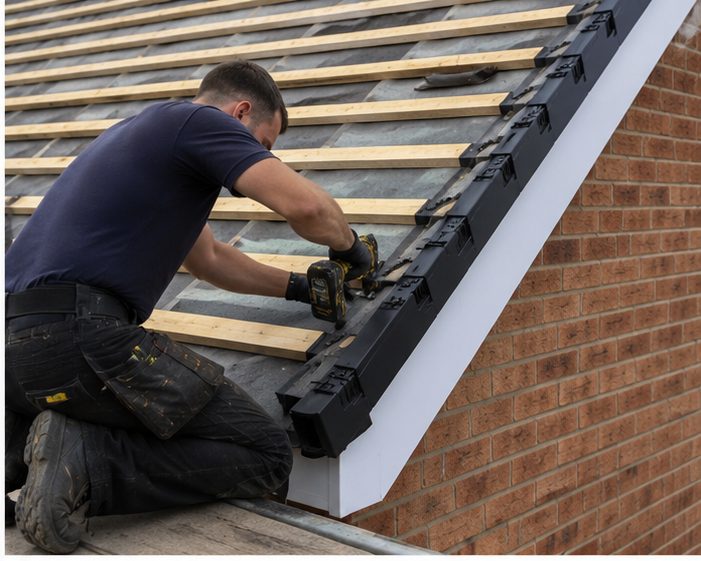
A dry verge uses mechanically fixed verge units and tile-end or cap pieces. They are fastened to the roof structure, to the tile maker's guidance, so the edge does not depend on mortar bonding. This gives a firmer hold in a gust and a defined seal against weather, birds and insects.
It does not make a roof storm-proof, and it cannot compensate for slipped tiles, tired battens or failed felt elsewhere on the slope. Think of it as removing the edge as the weak link, not as a promise that nothing will ever move in a gale.
- Mechanical fixing instead of wet mortar
- Resistance to wind lifting the roof edge
- Weather, birds and insects kept out
- No mortar fragments dropping onto paths
Checks before fitting
Compatibility depends on the tile profile, so we check this on site, along with the condition of battens and the timber at the edge. If the roof beneath is tired, we say so, because a good verge on a poor roof is a waste. The system suits new roofs, re-roofs and repairs where mortar has already failed.
Looking after the whole roof
A dry verge is one part of a sound roof. Ridges, hips, flashings and the tiles in between all need to be in order too. We look at the whole slope when advising, and explain what is urgent and what could wait, rather than treating the verge in isolation.
Gutter and fascia boards at the gable edge, usually called bargeboards, sit just below the verge. If they are tired it is sensible to see them as part of the same job, because a firm verge above a loose board below leaves the edge half done.
Frequently Asked Questions
Will a dry verge stop tiles blowing off?
It helps the edge hold firm and removes failing mortar as a weak point. It cannot hold a roof together if tiles elsewhere are slipping or the fixings have deteriorated. Ask us what we see on your roof.
Can it be added to an old roof?
Often yes, where the tiles and timbers are in reasonable order and the profile is compatible. We check on site, and may suggest repairs first so the new edge sits on a sound base.
Is it only for new roofs?
No. It suits new roofs and re-roofs, but also repairs where the mortar has failed on an existing roof. We look at the tiles, battens and edge before recommending it. Ask us if you are not sure.
Talk to our team about dry verge systems in Frenchay
Every roof is different — the fastest way to get an accurate answer is a quick chat with our team.