
Blisters, cracks and splits are symptoms with different causes: trapped moisture, movement, sun and weather, or poor workmanship. Knowing which one you have decides whether to repair or replace.
Flat roofs on garages, porches and rear extensions are common in Frenchay, from older cottages with later additions to larger houses with dormers and bay tops. The covering on each takes a daily beating from sun, frost and standing water. These defects are how it tells you it is struggling.
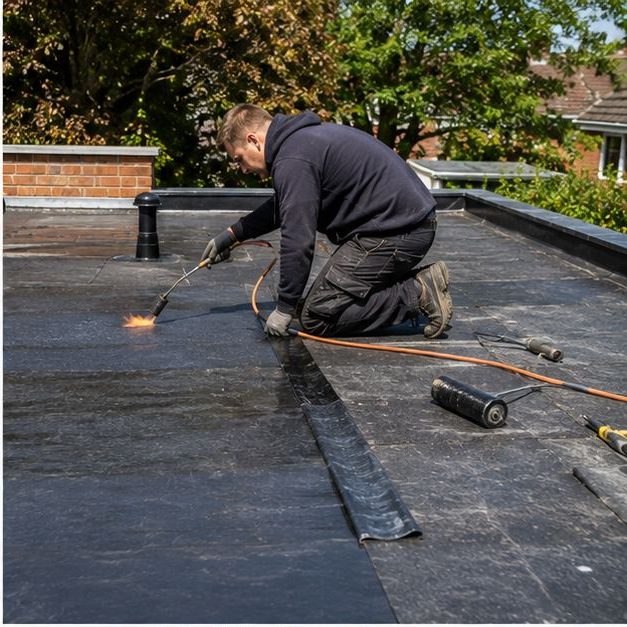
Why blisters form
A blister is a bubble where trapped moisture or air has pushed the covering away from the layer below. Heat then expands it. Water is often trapped during installation or enters through a small failure and cannot escape. Small, isolated blisters can be tolerable, but a cluster usually means damp is spread under the surface.
Sun matters more than people expect. A dark covering on a south-facing flat roof gets hot enough in summer to soften and stretch, then contracts hard on a cold night. Repeated cycles like that tire the surface and open weak points long before the covering looks old.
Why coverings crack and split
Roofs expand and contract with temperature, and the covering must move with them. Over time sun hardens and dries the surface, frost makes it brittle and movement at joints stresses it. Eventually a crack opens, often at a seam, corner or around a pipe, and water finds the gap.
Where the trouble tends to start
Stress concentrates at details: the junction with a wall, the edge trim, around outlets and rooflights and across old repair patches. A roof near trees may also gather leaves and debris that hold moisture. Poorly lapped seams and a thin finish at corners are classic points of early failure.
A visit to a flat roof is also a look at its edges and drainage, since many splits start where water has been standing at a trim or outlet. We check those at the same time as we look at the defect itself.
- Joints and seams that have lifted or opened
- Corners and upstands where the covering is folded
- Areas of standing water that cannot drain
- Old patches placed over damp material
Repairing what is sound
If the deck below is dry and sound, a blister or split can be cut out, dried and patched with compatible material, and joints resealed. We check the surrounding area for further damp before closing it up, because a repair over wet insulation only hides the problem for a short while.
When replacement is the better answer
Widespread cracking, many blisters, saturated insulation or a soft deck mean the roof as a whole is failing. Replacing the covering, with a sound deck and proper falls and upstands, is then better than repairing again. We explain what we find and why, using general materials such as single-ply rubber, fibreglass or felt systems.
Whichever route is right, the deck beneath is dealt with first. A sound deck, a correct fall and tidy upstands matter more to the result than the covering chosen to go over them. We would rather build that foundation properly than cover over a weakness.
Frequently Asked Questions
Can I just cut a blister open?
Please do not. Opening it without drying the area lets water in and spreads the damp. It needs to be cut, dried and repaired properly, and the cause of the moisture needs finding. The cause of the moisture matters as much as the repair.
Do cracks always mean a leak?
Not immediately, but a crack is an opening that will let water in sooner or later, particularly after frost. It is much easier to repair before the deck beneath has become wet. A small crack found early is a much simpler job than a failed deck.
Which flat roof material is best?
It depends on the roof's size, shape, access and what is beneath it. Single-ply rubber, fibreglass and felt systems each suit certain situations, and we recommend one after inspecting the roof itself. Material choice follows the condition of the deck.
Talk to our team about flat roofing in Frenchay
Every roof is different — the fastest way to get an accurate answer is a quick chat with our team.