
The drip and the hole are rarely in the same place. Finding a leak means following the water back through the loft and across the roof, one clue at a time.
Frenchay mixes older stone cottages and larger houses with plenty of modern estate roofs, and each type hides a leak in its own way. Water enters at one point, runs along timbers or felt, then drops somewhere else. Tracing it is patient detective work, and most of it can start safely indoors.
Begin with the stain, then look up
Note where the mark is, how it looks and when it appears: during rain, after it, or only in wind. Then go into the loft, if there is safe access, and look directly above it. A torch will show dark patches on timber, wet insulation or a drip hanging from a nail point. Stay on the boards or the loft hatch edge.
If the stain only appears during or after heavy rain, tell us. It narrows the search to coverings, flashings and valleys, whereas a stain that comes and goes with temperature points toward condensation or the loft environment. Those details cut the number of places we have to test.
Follow the water uphill
Water travels down the slope of a rafter or along the underlay before it drips, so the entry point is usually higher than the stain, sometimes by a good distance. Follow wet timber upward until it turns dry; the opening is near the last damp spot.
On older cottages with deep, heavy roof timbers, water can track sideways along them and appear near a wall. Modern estate roofs with lightweight trusses behave differently, and often drip fairly directly below the fault. Looking at the timber pattern shows us which type of roof we are dealing with.
Common culprits on the roof
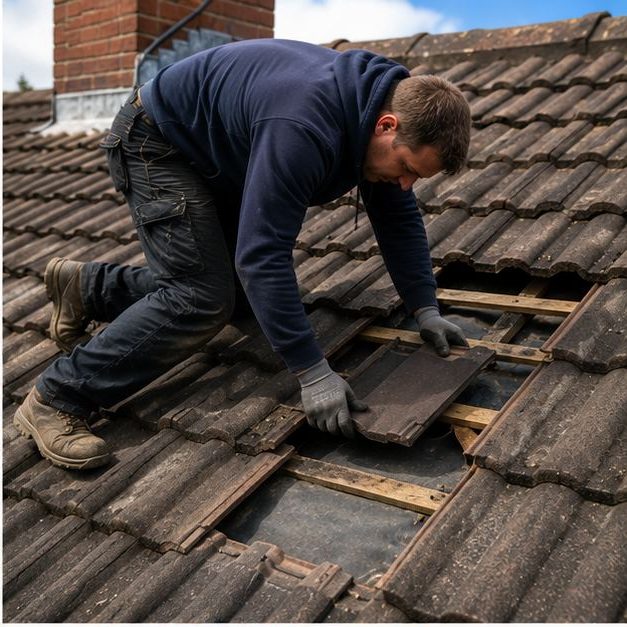
Once we know the area, we inspect the covering from outside. The usual causes are slipped or cracked tiles, failed ridge or hip bedding, worn lead flashings around chimneys and abutments, and blocked valleys or gutters. Leaks are more often at junctions and details than across plain tiled or slated areas.
- Cracked, slipped or missing tiles and slates
- Failed bedding along ridge and hip lines
- Lead flashings lifted at chimneys and walls
- Valleys and gutters overflowing or blocked
Things that look like leaks but are not
Condensation in a loft can drip from cold surfaces and mimic a leak, especially when roof ventilation is poor or insulation is packed over the eaves. Plumbing, overflow pipes and tank issues can do the same. We rule these out before assuming the roof is the problem, since the fix is quite different.
Gutters deserve a look as well. An overflowing or leaking gutter can soak the wall and eaves, and the damp appears inside as if it came from the roof. We check the gutter line and the fascia behind it. Fixing the gutter then stops the damp at its source.
What you can do before we arrive
Put a bowl under any drip, move belongings out of the way and photograph the stain. Make a note of the weather when it appears. Do not climb onto the roof to look; the evidence you gather indoors helps us find the source far faster than a guess from outside.
Frequently Asked Questions
Can a leak be found without going on the roof?
Often the loft gives most of the clues. Wet timbers, stained felt and daylight through gaps show roughly where water gets in. We then confirm it on the roof itself, which we do safely and with proper access.
Why does it only leak in some weather?
Wind-driven rain forces water under tiles and flashings from one direction, so a fault may only show when the wind blows that way. Slow leaks can also take hours or days to show up inside.
Will repairing the hole stop the stain?
The stain is already dry damage and will remain unless decorated over. Once the leak is fixed and the timber has dried out, the ceiling can be treated and painted; until then the mark may reappear.
Talk to our team about roof repairs in Frenchay
Every roof is different — the fastest way to get an accurate answer is a quick chat with our team.