
Covering old boards with new UPVC is sometimes possible, but only when the timber beneath is sound. Often it hides a problem that carries on quietly. Here is how we decide.
Capping old fascias with UPVC is a question we hear often, partly because it sounds quicker. On Frenchay houses, from older cottages with deep eaves to larger homes and later estates, the right answer depends on what the timber is doing underneath. Sometimes it works; frequently it does not.
What fitting over timber means
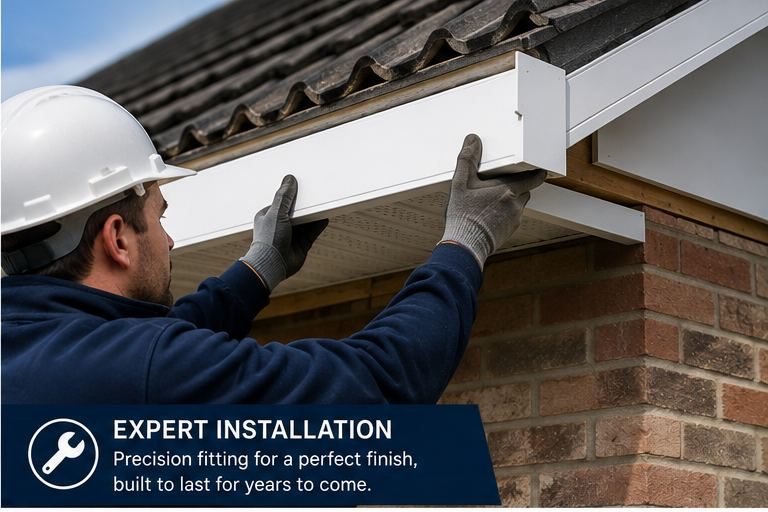
Fitting over timber, often called capping, wraps a new UPVC cover around existing boards instead of removing them. Gutters are taken off, the old surface is checked, and the new covering is fixed over the top. It can look neat, and avoids some disturbance to the eaves when the wood underneath is genuinely sound.
When it is a reasonable choice
Capping can suit a fascia that is straight, solid and dry throughout, with firm fixings into good rafter ends and no history of leaks. The old board then acts as a stable base for the new one. The result is neat and quick where conditions suit. Any questions you have along the way get a straight answer before the next stage starts.
Even then we look at the soffit and the roof ventilation, because covering the boards must not block the eaves or leave the roof space unable to breathe. That ventilation protects the timbers and the loft. Both matter equally. Nothing is hidden. We keep the explanation plain and show you what we have seen, so the decision stays with you.
When we advise taking the old boards off
If paint is flaking, wood is soft or there are signs of damp, covering it only hides the rot. Moisture stays trapped and the timber carries on decaying out of sight, then the fixings loosen and the gutter sags. A cover over a failing board is a false saving, and we say so plainly.
Capping also leaves the back of the old board unseen. Water can still reach the rafter ends from behind or above, and nobody sees the damage until something fails. That is why we treat the condition of the timber as the deciding factor, not the neatness of the finish.
- Soft or crumbling wood when probed
- Staining or damp at joints and corners
- Boards that bow or have pulled away
- Gutters that keep sagging after refixing
What proper replacement gives you
Removing the old boards lets us inspect the rafter ends, the wall plate and the eaves, fit new fascias and vented soffits, and refit gutters on a firm line. Older properties need care: we check what existing soffit boards are made of before disturbing them, and plan the work around that.
Making the call on site
We look at the boards from scaffold or a platform, test them and check the ventilation before recommending either route. Sometimes a short stretch is replaced and the rest capped. Whatever we suggest comes with the reasoning, and the work may need planning or Building Regulations checks — we advise before work starts.
Frequently Asked Questions
Is capping quicker than replacing?
It can be, because less is taken apart. But time saved is wasted if the old board is rotten, since the problem returns. We check the timber first and recommend the approach that suits its condition.
Will capped fascias still need cleaning?
Yes, as any UPVC does. It is cleaned with a mild solution rather than painted and is very low maintenance, though it will not stop the timber behind from moving or decaying if it is damp.
What about the soffits?
Soffits can be replaced at the same time, with vented boards or vent strips so the roof space breathes. We suggest doing both while the eaves are accessible, to avoid a second visit and extra scaffold.
Talk to our team about UPVC fascias and soffits in Frenchay
Every roof is different — the fastest way to get an accurate answer is a quick chat with our team.