
Mortar on the path is the verge asking for attention. The cause is usually movement, moisture and age, and patching the same spot again rarely holds for long.
Sweeping grey crumbs off a path or a drive is a sign worth taking seriously. In Frenchay, older stone cottages and larger houses often have verges that have been patched more than once, while estate roofs have edges that were never very thick. In every case, the fall of mortar tells a short story.
What the verge is made of
The verge is the roof edge along a gable, where tiles meet the wall. Traditionally the last tiles are bedded in mortar, which also seals the gap against rain. Mortar is hard but not flexible, so it cannot follow the small movements of the roof without cracking.
On a shared estate roof, a neighbour's gable may be losing mortar too, as the same builder fixed them all in the same way. That does not make it urgent, but it does mean the pattern is common and not a one-off fault with your house.
How it breaks up
Water gets into hairline cracks, freezes and widens them, and wind shakes the loosened mortar until pieces fall. Birds pick at the gaps and nest behind them. Eventually a section lets go and drops to the ground. Frost and rain do most of the damage. Any questions you have along the way get a straight answer before the next stage starts.
If you can see bare tile ends or a dark gap along the edge, the seal is already open and rain is reaching the timbers behind. It is best looked at promptly before the next gale. We look at it closely. Soon is best. We keep the explanation plain and show you what we have seen, so the decision stays with you.
Why patching does not last
New mortar over old, damp material bonds poorly and cracks again. If the tiles beneath have shifted or the batten has softened, the new bed is under the same strain as the old one. Repeated patching treats the symptom, which is why the same stretch of gable can need attention again and again.
- Fresh mortar cracking at the join with old
- Tiles at the edge sitting loose or out of line
- Gaps showing between tiles and wall
- Pieces landing on paths after each windy spell
The dry verge answer
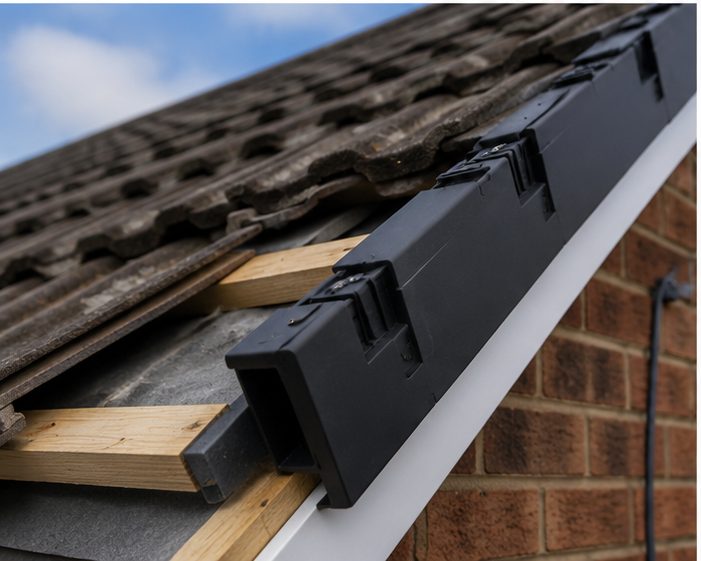
A dry verge swaps wet mortar for mechanically fixed verge units and tile-end or cap pieces. There is no mortar to crack or drop, and the edge is held down firmly, so wind has less to work on. It suits repairs where the mortar has failed, but compatibility depends on the tile profile and we check this on site.
What not to do
Do not climb up to fill gaps or press the mortar back, as loose edges bring tiles with them and the work is at height. Keep children and pets away from the area below, and call us for a proper look. We will advise whether re-bedding or a dry verge is the right route.
Frequently Asked Questions
Is falling mortar a sign the roof is failing?
Not necessarily the whole roof, but the verge is. It may be the first visible sign of tired edge tiles or battens, so we check the slope around it as well. Ask us what we find.
Can birds or insects get in once mortar falls?
Yes. Gaps along the verge let in birds, wasps and insects, and rain follows. A fixed verge system leaves far fewer openings, which is one of the reasons it is chosen. That also keeps the roof space drier.
Will a dry verge fit my tiles?
Usually, though it depends on the tile profile. We check on site and fix to the tile maker's guidance. Where it does not suit the roof, we explain the alternatives. Ask if unsure. We explain it.
Talk to our team about dry verge systems in Frenchay
Every roof is different — the fastest way to get an accurate answer is a quick chat with our team.