
The roof edge takes the worst of the wind, and a mortar verge is often the first thing to give. Here is how a dry verge helps on exposed Hotwells roofs and where its limits lie.
Wind hits a roof hardest at its edges and corners, where air is forced up and over the gable. In Hotwells, with exposed slopes on the Avon Gorge side, that effect can be strong. The verge, where tiles meet the gable wall, is a weak point if it relies on wet mortar. A dry verge changes how the edge is held.
Why the edge is the weak point
At the verge, the last row of tiles overhangs the wall with nothing beside it. Wind blows underneath, lifts the tile and puts strain on its fixings. If the bedding is old or cracked, a hard gust can strip away tiles and mortar together. Once one tile goes at the edge, neighbours have less support and more of the roof is exposed to the next blast.
On exposed slopes the pressure is not constant but comes in sharp gusts, and each gust works any loose tile a little further. Gaps at the verge also let wind get beneath the covering and push upwards from inside the roof.
What a dry verge does differently
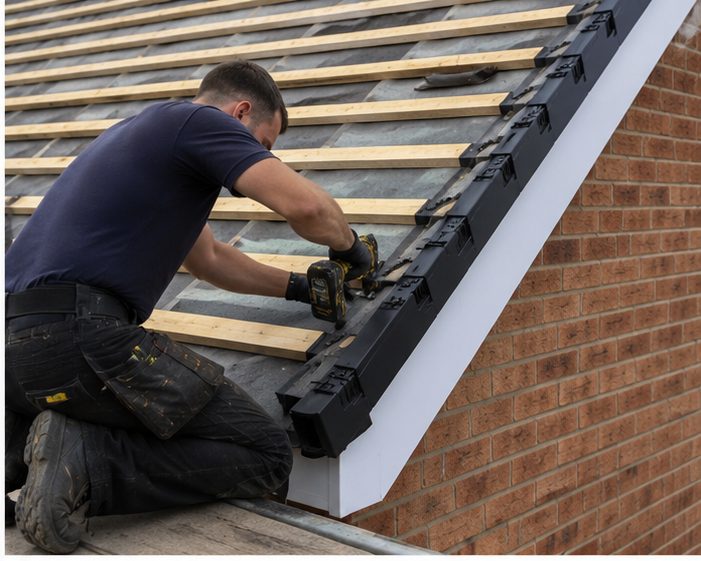
A dry verge uses mechanically fixed verge units and tile-end or cap pieces instead of wet mortar. They are screwed or clipped into the roof structure and hold the last tiles down firmly, so the edge does not rely on cement adhesion. There is no mortar to crack, shrink or wash out, and the closed edge keeps weather, birds and insects from getting in under the tiles.
- Mechanical fixing instead of mortar bond
- Edge tiles held against uplift
- No cement to crack or crumble
- Gap sealed against weather and pests
The fixing matters
A dry verge works only if it is fitted as the tile maker advises, with correct fixings and compatible pieces. The unit has to suit the tile profile, and that is checked on site, since some roofs need different parts. Fixings also need something sound to hold into. If the battens or rafters at the edge are rotten, they are repaired first.
What it will not cure
A dry verge does not make a roof windproof. If tiles in the main body are slipped, clips are missing or the felt is tired, wind will find those instead. It is not a cure for a roof failing elsewhere. We look at the whole roof, not only the gable edge, so you get an honest picture of where the risk lies on your slope.
Hotwells specifics
On exposed terraces, access to a gable edge can be tricky because of steep streets, so planning matters. We arrange safe working and make sure the verge is part of a considered repair or re-roof. Work like this may need planning or Building Regulations checks — we advise before work starts.
Where a gable end faces the open side of the gorge, it is worth looking at it more closely than the sheltered side, because it is the one that will show wear first. Many owners only notice the problem after a gale, so it pays to look before the next one arrives rather than after.
Frequently Asked Questions
Will a dry verge stop tiles blowing off?
It helps hold the edge tiles down much better than ageing mortar, but it works as part of a sound roof. Slipped tiles or poor fixings elsewhere can still lift. We check the whole slope. We explain this on site.
Can a dry verge be added to an existing roof?
Often yes, where the tile profile suits and the edge timbers are sound. We check compatibility on site, remove the failed mortar and fit the units following the tile maker's guidance. We explain this on site.
Is a dry verge only for new roofs?
No. It suits new roofs, re-roofs and repairs where the mortar has failed. Many owners choose it after finding mortar on the path, rather than repointing again and waiting for the next gale. We explain this on site.
Talk to our team about dry verge systems in Hotwells
Every roof is different — the fastest way to get an accurate answer is a quick chat with our team.