
The roof edge is where wind pulls hardest, and wet mortar there tends to crack and let go. A dry verge fixes the edge mechanically, which gives tiles better support in a gale.
Gable edges take the brunt of a gale, and Keynsham sits on open ground between Bristol and Bath where wind can come across the estates and over the older streets. When mortar at the verge fails, the tiles beside it lose their grip. That is why the edge is often the first place storm damage turns up.
Why the edge takes the punishment
Wind lifts and pushes at a roof, and the verge is where the roof stops and air flows around it. Pressure is strongest there, so tiles at the very edge are pulled harder than those in the middle. A solid fixing along the edge matters more than anywhere else on the pitch. Anyone who has found slates or tile ends in the garden after a storm will know how quickly an edge can go.
What happens to mortar in a gale
Mortar is brittle. Frost, sun and years of movement crack it, and then the wind finds the cracks. Pieces drop out, the verge tiles loosen, and a strong gust can lift them. A fall of mortar crumbs onto the path or drive is often the first sign that the edge is losing its hold. Once one piece goes, the next gust gets under its neighbour, and a small gap becomes a larger one.
How a dry verge holds the edge
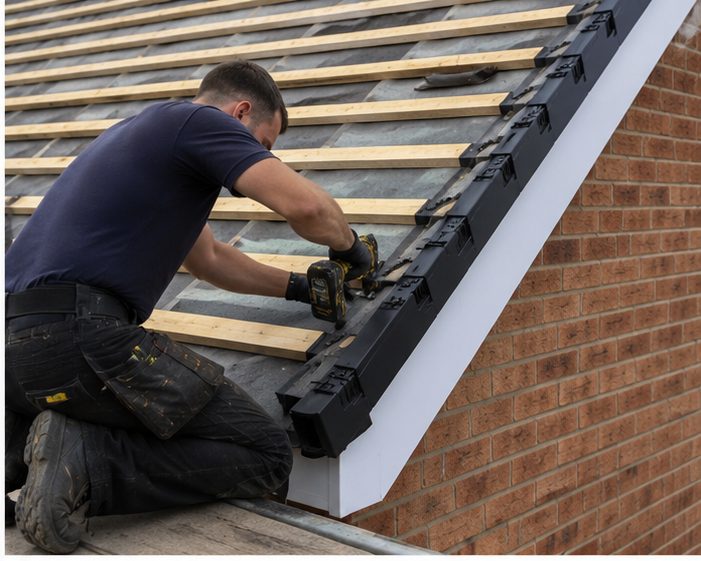
Dry verge units are fixed mechanically along the edge, fastened through the units to the batten or rafter below, following the tile maker's guidance. The tiles at the edge are held down by fixings rather than by wet mortar that can crack. That gives better resistance to wind at the point where it is most needed.
- Units and tile ends fixed to the roof structure, not stuck on
- No mortar to crack or fall away
- Edge tiles held tight along the whole run
- Fixings matched to the roof's tiles and battens
What it cannot do
A dry verge does not make a weak roof strong. If tiles are loose in the field, the ridge is cracked or the battens are rotten, the wind will find those instead. It is a good answer for the edge, not a cure for a roof failing elsewhere, so we look at the whole covering. If we find other weaknesses while we are there, we tell you plainly rather than bundling them into the job.
Fitting it to your roof
Whether a dry verge suits depends on the tile profile, and we check that on site. On a new or re-laid roof it goes in as part of the work. On an older roof it can replace failed mortar as a repair. Either way, the fixings are chosen to suit the tiles and the structure under them. Fixings and units are chosen for the particular tile in place, not a one-size approach.
Frequently Asked Questions
Is a dry verge stronger than mortar?
At the roof edge, it holds because it is mechanically fixed rather than relying on mortar that can crack and fall. For the exposed edge, that is the benefit. It still needs the rest of the roof to be sound.
Will it stop storm damage altogether?
No roof edge can promise that. A dry verge removes one weak point, but ridges, loose tiles and old flashings can still be damaged in a bad storm, so a general check after high winds is sensible.
Can I tell if my verge is weak from the ground?
Look for mortar on the path, gaps or cracks along the gable edge, or tiles at the edge that look out of line. Do not climb up to check. Call us for a proper look. If in doubt, ask us and we will explain what we find.
Talk to our team about dry verge systems in Keynsham
Every roof is different — the fastest way to get an accurate answer is a quick chat with our team.