
The verge is where wind gets its grip on a roof. Here is how a dry verge helps the edge tiles on Longwell Green's gable ends resist strong gusts, and what it cannot do.
Wind attacks a roof where it can get underneath, and the verge at a gable is one of the easiest places to do that. On the short verges of Longwell Green's modern tiled roofs, the end tiles are the first to feel a gust. A dry verge is designed to hold them. Here is how, and where its limits lie.
Why the edge is vulnerable
Air pushed against a gable wall rises up and over the edge of the roof, creating suction that tries to lift the end tiles. Mortar can crack and loosen under that repeated load. Once one tile at the verge moves, wind can get under the next, and a small gap can become a larger one very quickly in a storm. That suction is strongest at the corners and along the top of the gable.
How a dry verge holds the edge
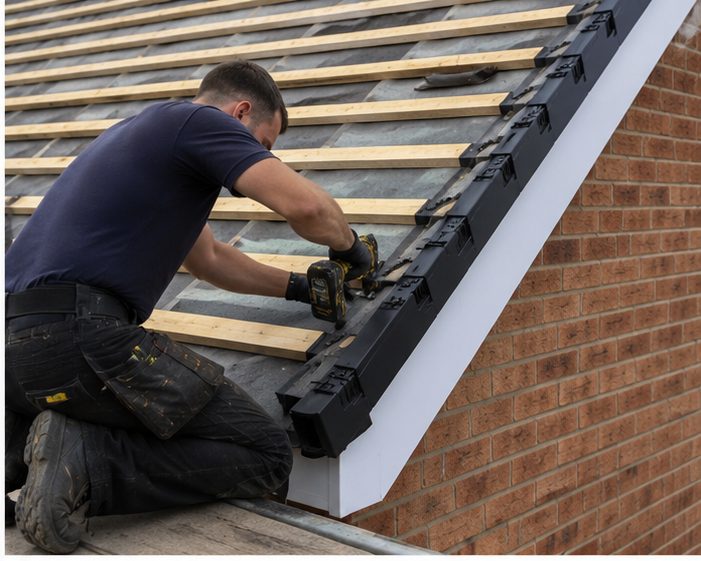
Instead of relying on wet mortar, a dry verge uses mechanically fixed verge units and tile-end pieces secured to the roof structure. They clamp the edge tiles down and give a more reliable defence against being lifted. Nothing is left to crack or crumble out.
Fixing follows the tile maker's guidance, so the system works as intended with your tile. Each unit is fixed to the structure, not to the mortar line, which is why the edge holds when gusts arrive from the side. The tile ends are held down in place instead of simply being stuck.
Other benefits at the edge
Beyond wind, the units close the gap at the verge, keeping weather, birds and insects out of the roof space. There is no mortar to drop onto paths or garage roofs, and the edge stays neater for longer. Garage gables and short verges, which are typical here, gain from the same arrangement. Everything is chosen to suit the tile and the wall.
- Better resistance to wind lift at the gable
- No mortar to crack, fall or stain
- Birds, insects and weather kept out
- Fixings that follow the tile maker's guidance
What a dry verge does not do
It is not a cure for a roof failing elsewhere. If the tiles across the slope are slipping, if the ridge is loose or the battens are tired, a new verge will not fix that. Whether the units suit your roof depends on the tile profile, which we check on site before recommending anything.
Our approach
We look at the verge from the ground and then closely at the tiles, the battens and the wall edge. If a dry verge suits the roof, we explain how it will be fitted and what it looks like. If something else needs doing first, we say so. The goal is an edge that stays put through the next storm. You get an account of what was found and what we recommend.
Frequently Asked Questions
Will a dry verge stop tiles blowing off?
It strengthens the edge, which is where wind lift is greatest. It does not make the rest of the roof storm-proof, so we check the whole roof and tell you honestly what else needs attention.
Does my tile type matter?
Yes. Units are matched to the tile profile, and compatibility is checked on site. Some profiles suit a dry verge easily, others need more care. We confirm before ordering anything. Matching the unit to the tile is part of the job.
Can a dry verge be fitted to an existing roof?
Often, when mortar has failed and the tiles beneath are sound. It is also fitted on new roofs and re-roofs. We look at what is there first, so you know it will work.
Talk to our team about dry verge systems in Longwell Green
Every roof is different — the fastest way to get an accurate answer is a quick chat with our team.