
Fitting new UPVC over old timber sounds quicker, but it only works if the wood beneath is sound. Here is how we decide on Longwell Green houses, new and old.
It is a fair question, and the honest answer is: sometimes. Capping existing boards can look tidy and save a little time, but it hides whatever is under it. On Longwell Green's later 20th-century estates and its older cottages alike, we look at the timber first and then say what is sensible.
What fitting over timber means
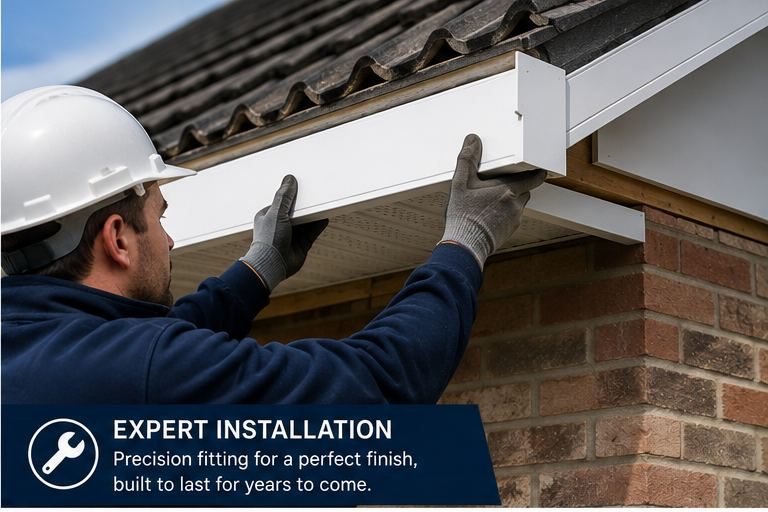
Some firms fix new UPVC covers or boards directly over the existing fascia and soffit. The old timber stays in place as a backing. It can work where the boards are solid, flat and dry. It does not work where the wood is soft, split or damp, because the new boards need something firm to be fixed to. Plenty of firms offer capping, and it suits some houses, so the point is to check, not to dismiss it.
The risk of covering a problem
Rot does not stop because it is hidden. If water has been sitting at the board and rafter ends, covering it can trap damp and let the decay carry on, unseen, behind the new boards. By the time anything shows, the rafters may be affected.
That is why we insist on seeing what is under the old boards before agreeing to cover anything. Only when the timber proves firm and flat do we talk about fitting over it, and even then we explain the limits.
What we check
We press along the fascia and look closely at the condition of the soffit, the gutter fixings and the rafter ends where we can reach them. Staining, soft spots, gaps and sagging all point towards removal. If everything is sound and flat, capping can be an option, and we say so honestly.
- Soft or crumbling timber when pressed
- Staining or stains running from the gutter
- Warped or uneven boards that will not sit flat
- Signs of damp at the rafter ends
Why removal is often better
Taking the old boards away lets us see the rafter ends and eaves, fix new boards to solid timber, and add vented soffits or strips so the roof space can breathe. Gutters come off and are refitted or replaced. Older cottages need extra care, and we check what the existing soffit boards are made of before disturbing them.
Our advice on site
There is no single answer for every house. We look, explain what we found and recommend capping or replacement, with reasons. UPVC is cleaned rather than painted and is very low maintenance, so getting the base right is worth it. Some work may need planning or Building Regulations checks, and we advise before work starts. We would sooner talk you out of a job than into the wrong one.
Frequently Asked Questions
Is capping over timber quicker than replacement?
It can involve less work in some cases, but only if the timber is sound. If we have to cure rot afterwards, the saving disappears. We look first and explain which option suits your boards.
Will capping hide rot?
It will hide it from view, and that is the concern. Decay can continue behind the new boards. That is why we check the timber and rafter ends before agreeing to fit over anything.
Can I keep my existing gutters?
Often yes, if they are sound and can be refitted neatly. But they have to come off to fit new boards properly. If they are cracked or sagging, replacing them at the same time makes sense.
Talk to our team about UPVC fascias and soffits in Longwell Green
Every roof is different — the fastest way to get an accurate answer is a quick chat with our team.