
Blisters, cracks and splits are the flat roof's way of showing stress. Here is what causes each on garage, porch and extension roofs in Longwell Green, and what we do about them.
Flat roofs on the garages and extensions of Longwell Green's later 20th-century estates have a hard life: sun, frost, standing water and decades of tiny movements. The surface eventually shows it as bubbles, hairline cracks or open splits. They look alike from below, but the causes differ, and so does the right repair.
Blisters and trapped moisture
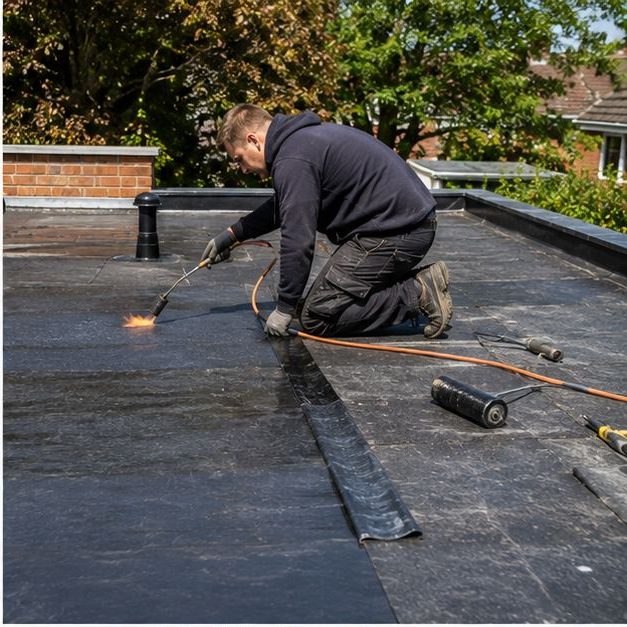
A blister is a raised bubble in the covering, usually caused by moisture or air trapped beneath it that expands in warm weather. Often it starts at a poorly sealed joint or where the deck was damp when the covering went on. Small blisters can sit unnoticed for ages, but they weaken the surface and can burst under foot or frost. We often find a small blister where a joint was never fully sealed.
Cracks and the effect of weathering
Sun and frost make a covering stiffen over time, and cracks follow in the places that move most: along joints, around the edges and over any step in the deck. The surface may look dry and perfect before the first hairline appears.
A crack that passes water is a leak in waiting, and the water often tracks beneath the covering before it shows inside. Left alone, that water can soak the deck below, so it pays to have a split or crack looked at before the next hard frost.
Splits and movement
Splits are wider openings, commonly where the structure has moved, such as at the junction of a garage roof and the house wall, or along a deck joint. Thermal movement, a settling extension or poorly supported edge trims all contribute. A split rarely fixes itself, and rain and frost will widen it. Any of these, found early, is easier to fix.
- Joints between boards or sheets opening up
- Roof meeting a wall and pulling away
- Edge trims lifting or coming loose
- Stress where pipes or rooflights pass through
What we check
We look at the extent of the damage, the condition of the deck below, whether water has got underneath, and how well the roof drains. We look at the loft or ceiling side as well. If the surface is generally sound, a patch or local repair may be enough. If the deck is wet or soft, the covering will need more than a patch. We put the findings in plain words.
Repair or replace
Repair suits roofs where the damage is isolated and the deck is dry and firm. Where blisters, cracks and splits are widespread, a new covering such as single-ply rubber, fibreglass or a felt system gives a more honest fix than repeated patching. We explain which applies, what each involves, and let you decide with the facts in hand.
Frequently Asked Questions
Can a blister be left alone?
Small ones can sometimes be watched, but a blister is a weak spot, and water can enter if it splits. It is better to have it looked at before the next frost or heavy rain.
Is a crack always a leak?
Not always, but it is a route for water. Some hairline cracks stay dry for a while, yet they widen with weather. We check whether water can pass and whether the deck beneath has been affected.
Can I seal a split myself?
A tube of sealant may hold briefly but rarely lasts, and it can hide a bigger problem. Only work from the ground and the loft side, and ask us to inspect before the damage spreads.
Talk to our team about flat roofing in Longwell Green
Every roof is different — the fastest way to get an accurate answer is a quick chat with our team.