
The edge of a roof takes the worst of a gale. A dry verge fixes the outermost tiles mechanically instead of relying on mortar. Here is how that helps on Montpelier's gable ends, and what it cannot do.
Wind gets under a roof at its edges first, and a mortared verge is only as strong as the bond holding it. When that bond cracks, tiles at the edge are the first to lift. A dry verge fixes those tiles mechanically. On Montpelier's tall, exposed gables, that extra grip at the edge is worth understanding.
Why the verge is the weak point
At a gable the last row of tiles stops at the wall, with only mortar and a bed beneath it holding the edge down. In a gale, air rushes up and over the gable and can pull at loose mortar and the tiles it carries. Once one piece goes, the next one sees more wind. A cracked verge is an open invitation for that to begin.
Montpelier's gable ends are tall and stand clear above neighbouring roofs on sloping ground, so they catch wind from several directions. Edge repairs here tend to be needed after storms, which is a good moment to rethink how the edge is fixed.
What a dry verge adds
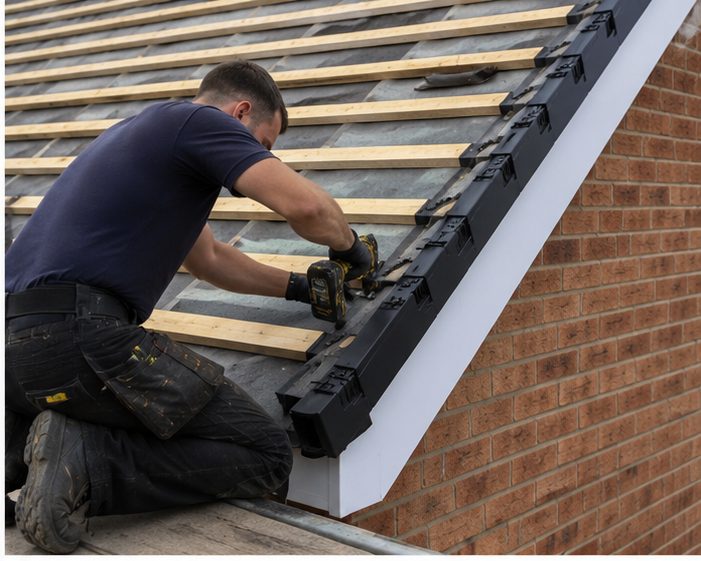
Dry verge units are screwed or clipped to the roof structure, and the tile ends and caps are mechanically fixed rather than bedded in. That gives better wind resistance at the very place wind attacks first, and there is no mortar to fail. It does not make a roof storm-proof, but it does remove the weakest part of the edge.
- Mechanical fixings instead of bedding mortar
- Edge units held to the roof structure
- Tile ends secured against uplift
- Nothing to crumble and fall onto paths
Fitted to the tile maker's guidance
The system must suit the tiles, so we follow the tile maker's guidance and check the profile on site before ordering anything. Not every tile takes every verge unit. Getting that match right matters more than the unit itself, because a poorly matched system leaves gaps and lets wind in just as old mortar did.
When it is the right answer
A dry verge suits new roofs, re-roofs and repairs where the mortar has already failed. In Montpelier, falling mortar on a drive or path and gaps along a gable line are typical signs. If the wider roof is tired, we say so, since the verge then sits on a roof that still needs work.
What it does not fix
A dry verge does not cure a roof that is failing elsewhere. Loose ridge tiles, slipped covering or poor flashing round a chimney still let wind and water in. Before recommending the work, we look at the roof as a whole, and tell you which jobs are urgent and which can wait. That keeps the money going where the roof needs it.
If you notice tiles sitting out of line along a gable, or pieces of mortar on the ground after a blow, mention it when you call, as that tells us where to begin. We would rather look at a loose edge early than clear up after a tile has come down onto a pavement or a neighbour's yard.
Frequently Asked Questions
Will a dry verge stop tiles blowing off?
It strengthens the edge, which is where wind does most harm, but it cannot protect a roof that is already loose or damaged elsewhere. It works best on a roof that is otherwise sound.
Is a dry verge better than mortar in wind?
For wind resistance at the edge, generally yes, because fixed units do not rely on a bond that cracks over time. We still check each roof, since the right choice depends on the tile profile.
Can I check my verge from the ground?
You can look for mortar on the ground, cracks or gaps along the gable edge and tiles that look out of line. Do not climb up to look; call us and we will give the edge a proper look.
Talk to our team about dry verge systems in Montpelier
Every roof is different — the fastest way to get an accurate answer is a quick chat with our team.