
Covering old timber with new UPVC looks like a shortcut. Sometimes it holds up, often it hides trouble. Here is how we judge it on the Victorian houses of Montpelier, and when the old boards should come off.
Fitting new boards over old ones is possible in some cases, but it is not a rule. What matters is the state of the timber underneath and what is hidden behind it. On Montpelier's older terraces and villas, where eaves have been painted and repaired for generations, we nearly always want to see the wood first.
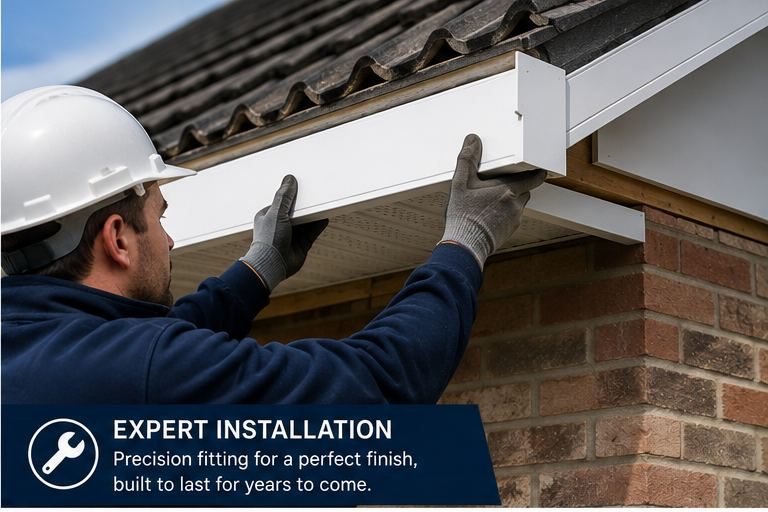
When capping over timber can work
If the existing fascia is sound, straight, dry and firmly fixed to the rafter ends, a UPVC cover can be fitted over it. That gives a clean, very low maintenance face without the paint. The rafter ends and eaves behind the board still need to be checked, so we look at them before anything goes on, and the timber must be in genuinely good condition.
When it is the wrong call
Covering rot does not stop it. Damp timber under a plastic cover cannot dry out and carries on rotting unseen, then pulls the new board loose. Warped or soft boards, flaking paint hiding decay and gutters that have been overflowing are all warnings. In those cases the old fascia and soffit are better removed so the rafter ends can be inspected.
- Soft or crumbling wood when pressed with a screwdriver
- Boards that have bowed or split along their length
- Black staining or fungus around the rafter ends
- Gutter brackets that have pulled loose from the board
What full replacement involves
We take down the gutters and the old boards, look at the rafter ends and eaves, repair or treat anything that needs it, and fit new fascias, vented soffits and bargeboards where needed. The gutters are then refitted or replaced. This takes longer than capping, but it gives a clean base and lets the roof space breathe through the new soffit vents.
Replacement also lets us correct small faults that capping would hide, such as uneven rafter ends or gaps where the old soffit has shrunk away from the wall. The result is a straighter line along the eaves, which shows from the street.
Older houses and what is behind the boards
Victorian houses sometimes have old boards that need careful handling. We check what existing soffit boards are made of before disturbing them, so nothing is broken up carelessly. In Montpelier's flats, access around bays and chimneys can also be awkward, so the way boards are removed and the scaffold is arranged is worked out beforehand.
Choosing the finish
UPVC is cleaned, not painted. White is common, though darker finishes and wood-effect ones suit coloured Victorian streets well and can sit better with the original look of a bay or porch. Whichever you choose, the board should be fixed to sound timber, jointed neatly at corners and finished so the gutter sits true.
Frequently Asked Questions
Is capping the lighter option than replacing?
Capping can involve less work, but it is only sensible on sound timber. If rot is found behind it, the cover has to come off anyway. We tell you which route is honest for your boards before deciding.
Will UPVC fitted over timber trap damp?
It can. Wet timber covered by plastic cannot dry out, so any hidden moisture stays put and spreads. That is why we check the timber and the rafter ends before agreeing to cap anything.
Do I need scaffold either way?
Almost always. Eaves work on a high Victorian house needs safe access, and tight pavements make planning important. We arrange it as part of the job and talk you through how it will sit before we start.
Talk to our team about UPVC fascias and soffits in Montpelier
Every roof is different — the fastest way to get an accurate answer is a quick chat with our team.