
The verge is where wind gets under a roof first. A dry verge fixes that edge mechanically instead of relying on mortar. Here is what it helps, and where its limits are.
On tall houses like many in Redland, the gable edge takes the brunt of a gale. Wind lifts at the verge, and loose mortar offers little to hold the tiles down. A dry verge changes how that edge is held. It helps a lot, but it is not a whole-roof cure.
Why the verge is the weak edge
Wind blows over the roof and curls around the gable, creating a lifting force along the verge. Tiles at the edge have nothing beside them to share the load. If the mortar bedding cracks, the row can loosen and become a hazard to anyone below.
Houses that stand tall and exposed feel this more, because the wind has a longer run at the gable. Chimneys add to the turbulence around the edge. A well-held verge therefore does a bigger job on a tall house than on a low one.
What a dry verge changes
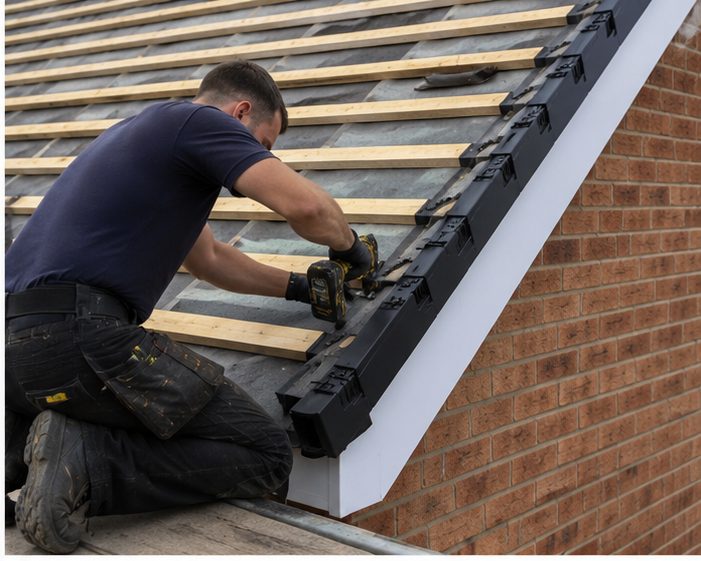
Instead of wet mortar, verge units and end pieces are screwed or clipped to the roof structure. Each one is held independently of the others, so no single crack lets a row slide. The line is also cleaner, with no loose crumbs falling on paths and drives.
- Units are fixed mechanically, not stuck with mortar
- There is no mortar to crack, shrink or wash out
- The edge tiles are held down firmly
- Weather and debris are kept out of the roof space
What it does not do
A dry verge does not strengthen tiles that are cracked or rusting clips elsewhere on the roof. If the main covering is tired, wind can still lift it away from the middle. That is why we look at the whole roof before saying the edge is all that needs doing.
Fitting to the tile profile
Different tiles need different verge units, and not every combination works. We check the tile profile on site and fix to the tile maker's guidance. On older roofs with slates or unusual tiles, a dry verge may not suit, and a traditional bedded verge, repaired properly, may be the right answer.
We would rather say a dry verge does not suit than fit something that will not sit right. Mixed or older tiles, and roofs with irregular edges, may need a different answer, and we explain what and why before any work begins.
After a storm
If a gale has loosened your verge, keep clear of the area below it and do not try to push tiles back. Tell us what you can see from the ground. We will make the edge safe, then explain whether a dry verge, a repair or a wider job is sensible.
Frequently Asked Questions
Will a dry verge stop tiles blowing off?
It makes the edge much better held, but no roof detail is proof against extreme weather. It is one part of a sound roof, and the rest of the covering still needs to be in good condition.
Is a dry verge only for new roofs?
No. It suits new roofs and re-roofs, and it is a sound repair where old mortar has failed and the tile profile allows it. Whether it fits depends on the tile, which we check on site before suggesting it.
What is the first sign my verge is failing?
Usually crumbs of mortar on paths and drives, or cracks and gaps along the roof edge when you look up from the ground. A slipped or leaning edge tile is another sign. Tell us what you see.
Talk to our team about dry verge systems in Redland
Every roof is different — the fastest way to get an accurate answer is a quick chat with our team.