
Fitting UPVC over old timber is possible in some cases, but it can hide trouble. Here is when it makes sense, when it does not, and why we usually prefer to strip back.
Many Redland houses still have their original timber fascias, painted again and again. Covering them with UPVC looks like a shortcut, and sometimes it is a sound one. More often the board underneath is hiding rot, so the first job is always to find out what is behind it.
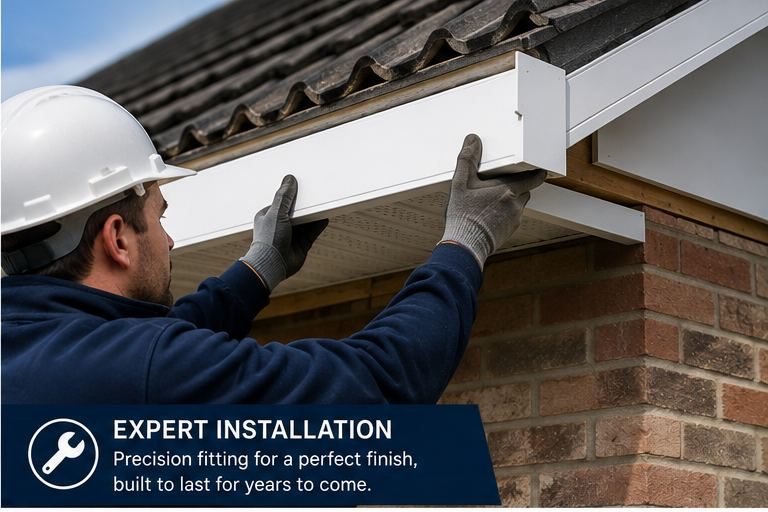
The short answer
Yes, UPVC cladding can be fixed over timber that is sound, straight and firmly attached. It is not a repair for timber that has gone. Whether it is the right choice depends on the condition of the board, the rafter ends behind it and the way the gutter is held.
Why covering over can be risky
A new face over a damp board does not stop the damp. Rot can carry on unseen, spreading into rafter ends and the eaves while the white finish looks perfect. By the time something shows, the repair is bigger. We would rather see it before it is covered.
A painted board that looks fine from the pavement may be soft behind the paint. Moisture often enters at a joint or from a leaking gutter, and the damage starts at the back or the underside, where you cannot see it. That is why a quick glance from below is not enough for us.
- Soft timber cannot hold fixings or support a gutter properly
- Hidden rot can spread into rafter ends
- Old paint and uneven boards leave gaps behind the new face
- Airflow at the eaves may be blocked by the old soffit
When capping can make sense
If the timber is dry, solid and straight, and the roof edge is otherwise in good order, a cover can be a tidy and very low maintenance finish. We check the whole run with a probe and by eye before offering it, and we say if only part of the house suits it.
What full replacement involves
We remove the old boards and gutters, check rafter ends and eaves, replace anything damaged and fit new fascias and soffits. Vented soffits or strips let the roof space breathe. Gutters are refitted or replaced. Scaffold is normally needed on a house of this height, and we arrange it as part of the job.
On larger older houses the eaves can be built in more than one way, so we check how the gutters are held and how the roof edge is put together before deciding how to proceed. We explain what we expect to find, so nothing comes as a surprise on the day.
What to ask
Ask whether the old boards will be taken off or covered, what is being done about the rafter ends, how the roof will be ventilated, what finish and colour are offered and how access is arranged. A clear written answer to each of these tells you what you are being offered.
Frequently Asked Questions
Is it quicker to cover the old timber?
It can mean less to remove, but the honest comparison is between a cover that hides the board and a full replacement that lets us inspect it. We talk through both so you can choose with the whole picture.
Can UPVC be painted if I want a different colour?
UPVC is cleaned rather than painted. Finishes come in white, darker colours and wood-effect, so choosing the right one at the start matters. We can talk through the options that suit an older house of this style.
How do I know if my fascia is rotten?
From the ground, look for peeling paint, dark patches, soft or flaking edges and a gutter that sags. Those signs mean the board needs a closer look. Please do not poke at it from a ladder; call us and we will check.
Talk to our team about UPVC fascias and soffits in Redland
Every roof is different — the fastest way to get an accurate answer is a quick chat with our team.