
Wind pulls hardest at the edge of a roof, and mortar there is the weakest link. A dry verge holds the edge tiles with fixings, so they depend on metal and plastic rather than old mortar.
The edges of a roof take the worst of a gale, and gable ends are the most exposed part. On concrete-tiled Yate estate roofs, the verge tiles rely on bedding that dries and cracks with time. A dry verge replaces that bedding with fixings made to resist uplift.
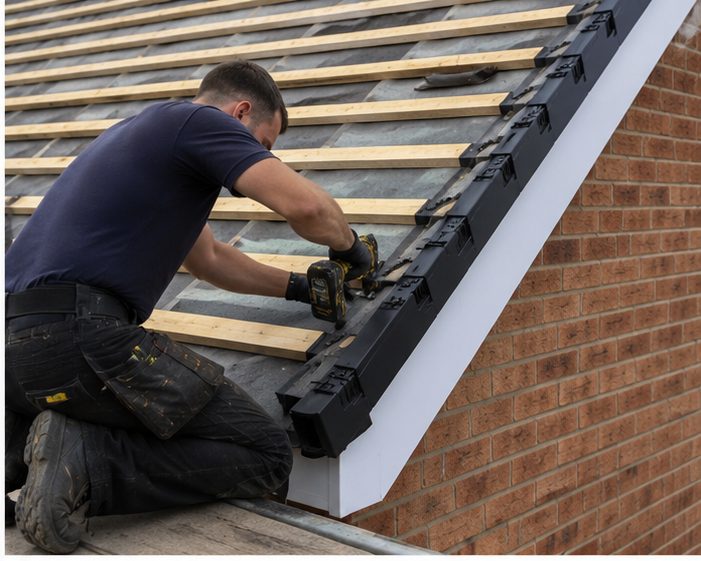
Why the verge is the weak point
Wind flows up and over the gable and tries to lift the edge tiles. Mortar holds them by weight and adhesion alone, and once it cracks, a gust can break the tile free. Falling tiles are a danger to people below and leave a gap that rain then enters. The edge is where storm damage tends to start. Short verges on garages and porches share the same exposure, even though the roofs are small, and they tend to be overlooked.
What the dry system does
Verge units are screwed or clipped to the roof structure and the tiles, with cap or end pieces locking the edge in place. There is no mortar to fail or fall. Fixings follow the tile maker's guidance for the profile, so each piece is held mechanically against uplift.
- Edge tiles fixed positively, not just bedded.
- No mortar to crack or drop out.
- Verge units shaped for the tile profile.
- Neat finish along the gable edge.
- Fewer repairs to the edge after storms.
What it does not do
A dry verge helps the edge, but it is not a cure for a roof failing elsewhere. If the field tiles are slipping, the ridge is loose or the battens are poor, wind will still find them. We look at the whole covering and tell you plainly if other work is worth doing alongside the edge.
Where it makes most sense
It suits new roofs, re-roofs and repairs where the old mortar has already failed. If you are seeing mortar crumbs on the drive or a visible gap along a gable, that is a sign the edge is losing its grip. Garages and porches with short verges can be tidied up at the same visit, since the work is similar. A quick look at the gable end from the garden or pavement can show cracked or missing bedding without anyone going near the roof.
Checking before we fit
Compatibility depends on the tile profile, so we check on site that the dry system fits yours. We also look at the batten and the state of the rafters at the edge, and fix anything weak first. Some work may need planning or Building Regulations checks, and we advise before work starts. Where we find weak battens or timber at the edge, we advise on repair before the dry system goes on, so the fixings have something solid to hold.
Frequently Asked Questions
Will a dry verge make my roof storm-proof?
No roof is storm-proof, but fixing the edge positively reduces one of the most common failure points. It works best as part of a sound roof, with the rest of the covering in good order.
Can it be fitted to an existing roof?
Often, yes, where the old verge mortar has failed or the edge is being repaired. We remove the old bedding and fit the dry units to suit the tile profile, checking compatibility on site first.
How can I tell my verge mortar is failing?
Look from the ground for cracks along the gable edge, missing sections or crumbs on paths and drives. Any of those are signs worth a call, and we can assess it with proper access.
Talk to our team about dry verge systems in Yate
Every roof is different — the fastest way to get an accurate answer is a quick chat with our team.