
Mortar has finished roof edges for generations; dry verge units are a newer way to do the same job. We compare how each behaves and where each fits.
Both finishes close the gap between the last tile and the gable wall. Mortar is bedded wet and left to set. A dry verge is fixed mechanically with no wet mortar. Henbury has older stone houses and cottages as well as inter-war and post-war estates, and the better choice depends on the roof, not on fashion.
How mortar behaves over time
Mortar is rigid. The roof moves, the weather freezes and soaks it, and sooner or later hairline cracks open. Pieces drop onto the path or drive, wind and rain reach the tile ends, and the edge begins to loosen. Repointing can restore it, but the same cycle tends to start again.
How a dry verge behaves
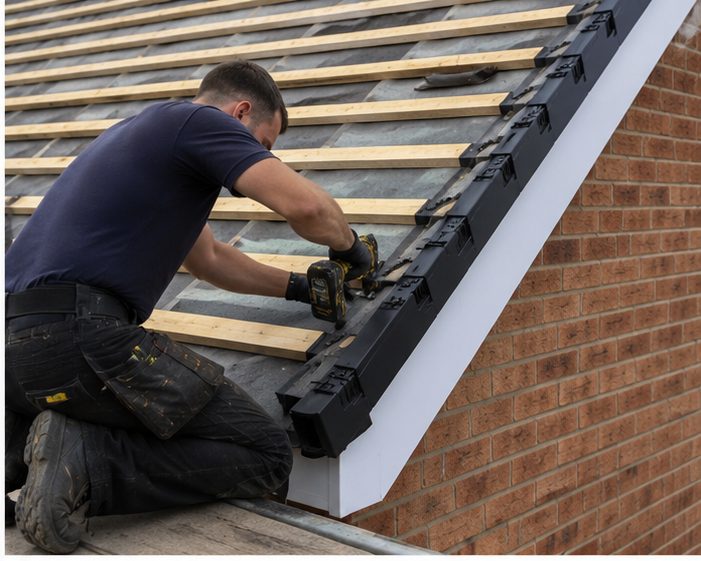
Dry verge units are screwed or clipped to the roof structure, with matching end pieces holding the tile ends. With no mortar to crack, there is nothing to fall out. The fixings add wind resistance at the edge, where gusts do the most lifting, and the closed edge keeps weather, birds and insects out. The result is an edge that stays closed through frost, rain and gusts.
- Fixed to the tile maker's guidance
- No wet mortar to fail
- Better resistance to wind lift at the edge
- Edge closed against birds and insects
Where mortar still makes sense
On some older roofs the look and tile type suit a traditional mortar finish, and if the existing bed is sound there may be no need to change it. Matching an old edge can be a sensible choice, and we will say so rather than push a different system. Either way, the roof is looked at as a whole before the edge is touched.
Where a dry verge is the better call
When the mortar keeps failing, when the roof is being re-covered, or when the tile profile has a matching dry verge unit, dry verge is usually the more reliable option. It suits new roofs and repairs where the mortar has failed. It will not rescue a roof that is failing in other places. Where gables are exposed, that extra wind resistance counts for a lot.
- Mortar repeatedly cracking and falling
- Re-roofs where the edge is rebuilt anyway
- Exposed gables that catch the wind
Checks before you decide
We check the tile profile, the edge timbers and the general state of the roof on site. Ask for the proposed method in writing, including how the units will be fixed and how the ridge junction will be dealt with. Falling mortar on the drive is usually our cue for a closer look. That keeps you from paying for an edge repair that the rest of the roof cannot support.
Frequently Asked Questions
Is a dry verge always better than mortar?
Not always. It tends to perform better where mortar has failed or where wind exposure is a concern, but the roof must suit it. We recommend what fits the tiles and condition of the roof. Honest advice depends on seeing the roof.
Will a dry verge look different from mortar?
The edge looks cleaner, with neat end pieces in place of a mortar line. Colours are chosen to suit the tiles, and we can talk you through the options on site. We can show you sample finishes before any work begins.
Can mortar be repaired instead?
Yes, where the existing bed is mostly sound. If it keeps cracking and falling out, repairs only last until the next cold spell, and a dry verge is generally the better long term answer for the edge. We will give you an honest view of which makes sense.
Talk to our team about dry verge systems in Henbury
Every roof is different — the fastest way to get an accurate answer is a quick chat with our team.