
A dry verge swaps crumbling mortar at the roof edge for fixed units. This guide explains how the parts fit together and why it suits a gable end in St Pauls.
Where a pitched roof ends at a gable wall, the edge tiles need to be held down and the gap to the wall sealed. A dry verge does both without wet mortar. In a busy street where a falling piece of mortar lands on a pavement, that matters more than it might seem.
The problem with mortar at the edge
A mortar verge is bedded wet, then dries and cracks as the roof and wall move at different rates. Water gets into the cracks, frost and wind work them loose, and pieces fall. Once the edge is open, rain, birds and insects get into the roof space, and the edge tiles can lift in a gale.
Mortar dropping onto a pavement or forecourt in a street with plenty of foot traffic is more than a nuisance, which is one reason many owners in built-up areas choose to remove the risk altogether. Taking mortar out of the picture means one less thing to chase.
How the dry system is built
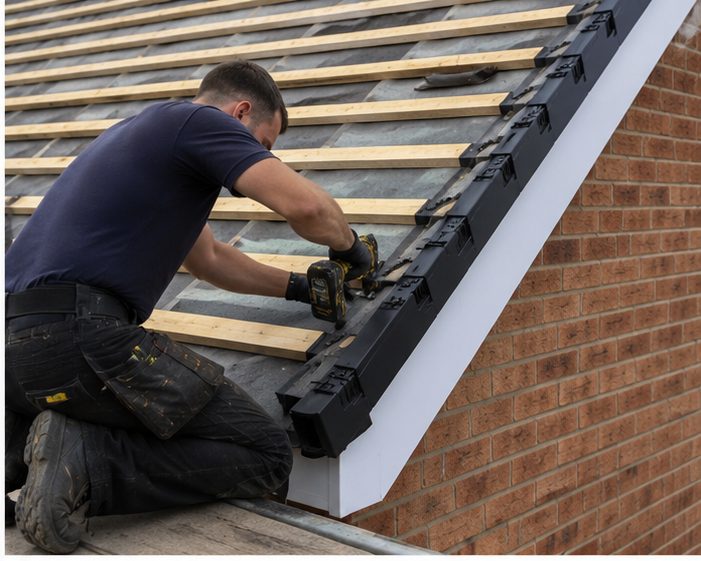
Verge units are fixed along the edge with mechanical fixings, and shaped pieces finish the ends of the tile courses. A cap or end piece covers the joint. Nothing relies on mortar, so there is nothing to crack, and the tiles at the edge are held down by the fixings instead.
- Verge units fixed along the roof edge
- End and cap pieces at the top and bottom
- Mechanical fixings instead of wet mortar
- Fitting to the tile maker's guidance
What it does for the roof
The edge stays sealed against weather and keeps birds and insects out of the roof space. The fixings give better resistance to wind lifting the tiles at the gable, where the force is greatest. It also needs less attention than mortar, though it is a good idea to have the roof looked at now and then.
For flats and converted houses where several people share responsibility for the roof, a verge that needs little attention is a practical advantage, because there is less to argue over later. Fewer repeat visits is the real gain. Over time that adds up to a calmer, tidier gable.
Where it is used
It is used on new roofs, on re-roofs and as a repair where the old mortar has failed. It suits many tile types, though compatibility depends on the profile, which we check on site. A dry verge does not cure a roof that is failing elsewhere, so we look at the whole roof as well.
What to expect on the day
We remove old mortar and loose edge tiles, check the timbers and undercloak beneath and put right anything weak. The new verge system is then fixed to the maker's guidance and finished neatly. It may need planning or Building Regulations checks — we advise before work starts.
- Edge cleared and made sound
- Verge units and cap pieces fixed
- Neat finish along the gable
- Site cleared of old mortar and debris
Frequently Asked Questions
What does dry mean in a dry verge?
It means no wet mortar is used to hold the edge. The verge units are fixed mechanically instead, so there is no mortar to dry out, crack or fall onto a path below.
Does a dry verge look different from a mortar verge?
Slightly. It looks cleaner and more uniform, because the pieces are made to fit. Some people prefer the look and others like the traditional mortar line, so we talk through the finish before work starts.
Is a dry verge suitable for an old roof?
Often, if the tiles are compatible and the edge is sound enough to fix to. We check the tile profile, the rafters and the edge on site first, and tell you if another approach would be better.
Talk to our team about dry verge systems in St Pauls
Every roof is different — the fastest way to get an accurate answer is a quick chat with our team.