
Ridge tiles and lead flashings are the joints of a roof, and they take the weather first. This guide explains how each repair is carried out on the older terraces and converted houses of St Pauls.
The ridge and the lead work are where one part of a roof meets another, so they move, crack and let go before the main tiled slopes do. On a dense run of Georgian and Victorian terraces they also meet party walls and chimney stacks, which gives water plenty of places to find a way in.
What the ridge does
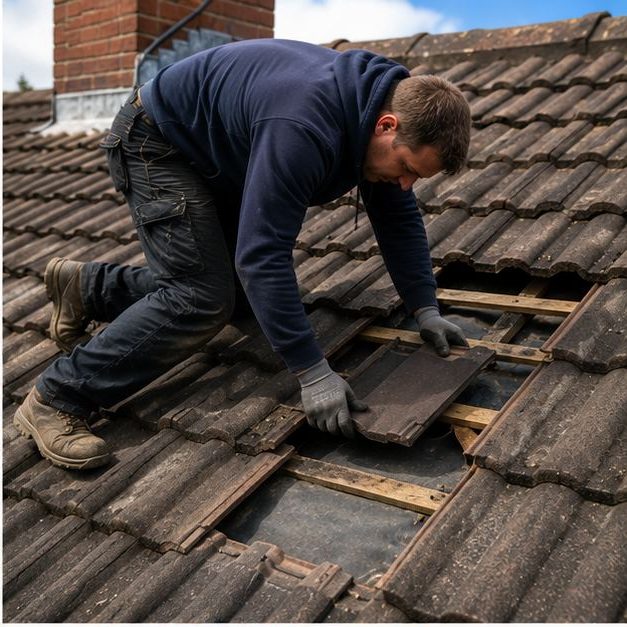
The ridge is the line along the top where two slopes meet. Ridge tiles are bedded on mortar or fixed dry, and they shed water over the join below. Over time the mortar cracks, tiles shift in wind and gaps open, letting rain and draughts into the roof space.
On tight terraces the ridge often runs the full length of several adjoining roofs, so a failure at one end can be linked to the condition of the next stretch along. We look along the whole line, not just the obvious gap, before agreeing what to do.
What a ridge repair involves
We start by checking how many tiles are loose and whether the mortar is failing along the whole length or just in places. Loose tiles are lifted, old bedding is raked out, and the ridge is re-bedded and pointed, or refixed with a dry system where that suits the roof.
- Removing loose and cracked ridge tiles carefully
- Clearing old crumbled bedding from the joint
- Re-bedding or mechanically fixing the tiles
- Checking hips and the tiles beside them
Where lead flashing is used
Lead seals the junctions a tile cannot: around chimney stacks, where a roof meets a taller wall, along party walls between terraced houses, and in valleys and gutters. It is shaped to the joint and tucked into the masonry so water runs out over the roof covering.
Because so many houses here are joined, party wall flashings are common, and they need to be sound on both sides of the line to keep rain out. A flashing that is tight on one side but loose on the other is a common cause of a slow leak. We check both faces of the junction before deciding what to renew.
How lead goes wrong and what we do
Lead can lift where the wedging has loosened, split where it has been bent, or pull out of a worn mortar joint. A short section can often be renewed or re-dressed. Where it is widely cracked or has slipped from the wall, we recommend replacing that run so the repair does not fail again.
- Re-wedging and repointing lead into the masonry
- Replacing split or lifted sections
- Renewing aprons and soakers at chimneys
- Sealing and lining valleys properly
What to ask any roofer
Ask what has actually failed, where the water was getting in and whether the work covers the ridge only or the surrounding tiles too. A good roofer explains the repair, describes the materials and tells you honestly if the problem is wider, with the roof assessed as a whole.
Frequently Asked Questions
Can lead flashing be repaired or must it be replaced?
Small lifts and loose edges can often be re-dressed and re-secured. Where the lead is cracked in several places, thin, or pulling away from the wall, replacing that section is more reliable. We look at the whole run before deciding.
Is re-bedding a ridge a big job?
It is usually a contained piece of work, though it depends on the length of the ridge and how many tiles are damaged. Access is arranged beforehand, and we tell you what the repair covers before the work starts.
Will repairs to the ridge stop a leak in the room below?
They will if the ridge was the source, but water travels along timbers before it drops. We confirm the cause by checking the roof space and the covering, so the repair is aimed at the real fault.
Talk to our team about roof repairs in St Pauls
Every roof is different — the fastest way to get an accurate answer is a quick chat with our team.