
The flat part of a roof is rarely where the trouble starts. Edges, upstands and wall junctions take most of the movement, and in a tight St Pauls terrace they are where the water finds a way in.
On a flat roof the middle of the surface does the easy work, while the edges and the junctions with walls do the hard work. In St Pauls, flat roofs often butt up against taller brickwork on older terraces and converted houses, so there are plenty of abutments where a small failure becomes a steady leak.
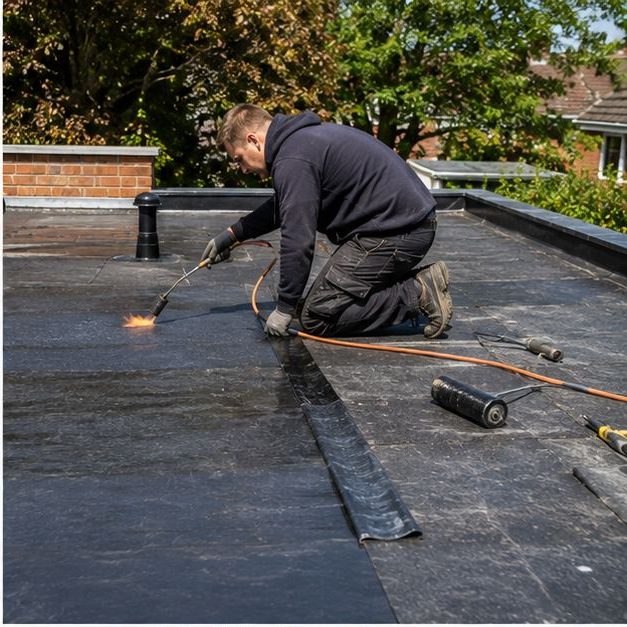
What an upstand is
An upstand is the short vertical turn of the covering up a wall or kerb, so water cannot run behind it. It is usually capped with flashing or tucked into the masonry. If the top edge lifts, or the covering pulls away at the bottom, rain runs straight behind.
Where the roof sits against a shared or neighbouring wall, we also look at how that wall is built, since movement from either side can pull a junction apart. We note which side the movement is coming from before choosing how to repair it.
Why abutments with older walls fail
Older brick and render move with the seasons, and the roof moves differently. Mortar joints weather and open, render cracks and the sealant or flashing pulls loose. A junction that was watertight when it was made can open up quietly, and the leak appears in the room below long after.
Edge trims, drips and gutters
At the open edge, a trim carries water off the roof into the gutter. If the trim has lifted, cracked or been fitted without a proper drip, water runs back under the edge and into the deck. A blocked or sagging gutter beside the roof makes this worse by holding water against the edge.
- Lifted or cracked edge trims
- Gutters that hold water at the roof edge
- Covering that has shrunk back from the edge
- Open joints between edge sections
What we check on site
We look closely at every upstand and edge, feeling for loose covering and gaps, and checking how the flashing meets the wall. Inside, we check ceilings and timbers at the same line. Cutting out and renewing a short section often solves it, but only once the true cause is found.
- Height and condition of each upstand
- How the top edge is sealed or flashed
- Whether the deck beside the edge is still firm
The repair itself
A good repair strips back the failed section, dries and, if needed, renews the deck, then rebuilds the upstand to a sound height with a proper flashing or termination at the top. Sealant alone is only a stopgap, so we explain where sealant is enough and where the junction needs rebuilding.
Where a junction has been repaired several times, we prefer to rebuild it properly once, rather than add another layer over the old one. That way the junction is dealt with at its source, and you are not paying to return to the same spot. It is neater and more reliable.
Frequently Asked Questions
Is it just sealant that is needed at the wall?
Occasionally a neglected joint only needs re-sealing, but sealant dries and cracks, so it is rarely a lasting fix on its own. We check whether the upstand and flashing underneath are sound first.
Why does my flat roof only leak at one corner?
Corners are where edges, upstands and outlets meet, and they take the most movement. Water also tends to collect in the lowest corner. We trace the path rather than assume the leak is where the stain is.
Can edges be repaired without replacing the whole roof?
Yes, if the rest of the covering and the deck are sound. A localised repair at the edges and upstands is common. If the problem is widespread we say so, and explain why a full replacement makes more sense.
Talk to our team about flat roofing in St Pauls
Every roof is different — the fastest way to get an accurate answer is a quick chat with our team.