
Not every leaking flat roof needs ripping up. The honest answer depends on how far the damage has spread and what the deck beneath is like.
Many larger Henleaze houses have a flat roof somewhere: a rear extension, a garage, a porch, a dormer cheek or a bay top. When one starts to leak, the question is always repair or replace. We look at the covering, the deck beneath and the details around the edge before giving a straight view, and this guide explains how we decide.
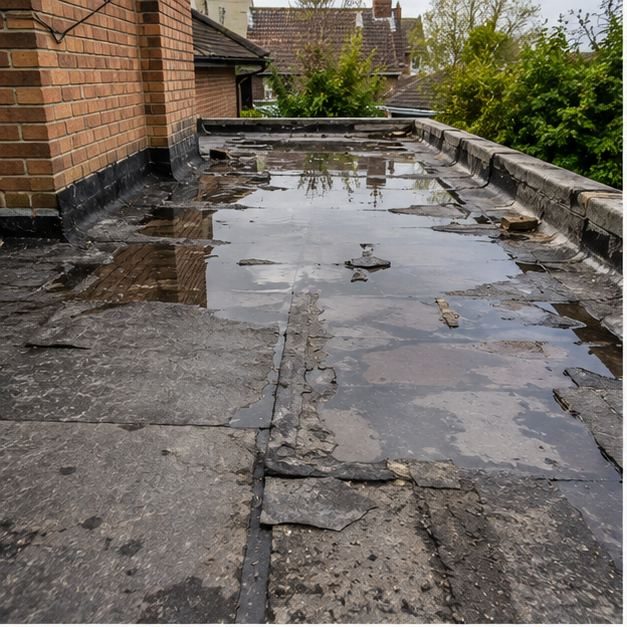
What we look at first
We start with the surface: ponding water, blistering, cracks, splits and open joints. Then we check outlets, edge trims and the upstands where the roof meets a wall. A small, isolated fault on an otherwise sound covering can often be mended. A covering that is crazed or splitting in several places is a different job altogether. That first look from the ground and from inside usually tells us which way the answer is heading.
When repair makes sense
A repair suits damage that is local: a split along one seam, a torn patch, a failed joint at an upstand, or a blocked outlet causing a puddle. The area is cleaned, dried and patched or re-sealed with a compatible material, and we confirm the surrounding covering is still firm. The test is whether the roof will still be sound around the repair, not just at it.
- One or two clean splits or punctures
- Failed seam or lap in an otherwise sound covering
- Open edge trim or loose flashing strip
- Blocked outlet that caused the problem
When replacement is the sensible route
If the covering is breaking down in many places, repairs become a recurring bill. The same goes where we find soft or rotten decking, saturated insulation, or water running beneath the surface. Replacement means stripping the old covering, repairing or renewing the deck, improving falls so water drains, and laying a new system such as single-ply rubber, fibreglass or felt.
What the deck tells us
The deck is what decides it. If the boards beneath are sound and dry, a new covering sits on solid ground. If they are spongy or darkened, they must be renewed before anything goes on top. On older extensions and dormers, we sometimes find the roof was laid with little fall at all, so water sits. We point this out and say what correcting it involves.
Choosing between materials
Single-ply rubber, fibreglass and felt systems all have a place. The right choice depends on the shape of the roof, the number of penetrations and edges, and how it is reached. We explain why we suggest one over another. Where work may need planning or Building Regulations checks, we advise before work starts. We would rather explain the trade-offs than push one option.
Frequently Asked Questions
Can a repair be done on a roof that is already patched several times?
Sometimes, but repeated patches are a sign the covering is giving up. We check whether the surrounding material is still sound. If not, we say so and discuss replacement rather than add another patch that will not last.
Why does my flat roof leak in one place and stain in another?
Water travels beneath the covering and along the deck before it finds a way through. So the ceiling stain is often away from the real fault. We trace the entry point rather than patching above the stain.
Do I need to replace the whole roof or just part of it?
Where a flat roof has separate sections, such as a porch and an extension, only the failing one may need replacing. If one covering runs across a large area and is breaking down generally, partial work rarely holds.
Talk to our team about flat roofing in Henleaze
Every roof is different — the fastest way to get an accurate answer is a quick chat with our team.