
The middle of a flat roof is rarely where it fails. Edges, trims and upstands are the junctions where movement and weather concentrate, and where most leaks begin.
A flat roof covering can look perfect in the middle and still let water in at its perimeter. On the extensions, garages, dormers and bay tops of Henleaze, the weak points are almost always the edge trim and the upstand where the roof meets a wall. This guide explains why they fail and what repairing them properly involves.
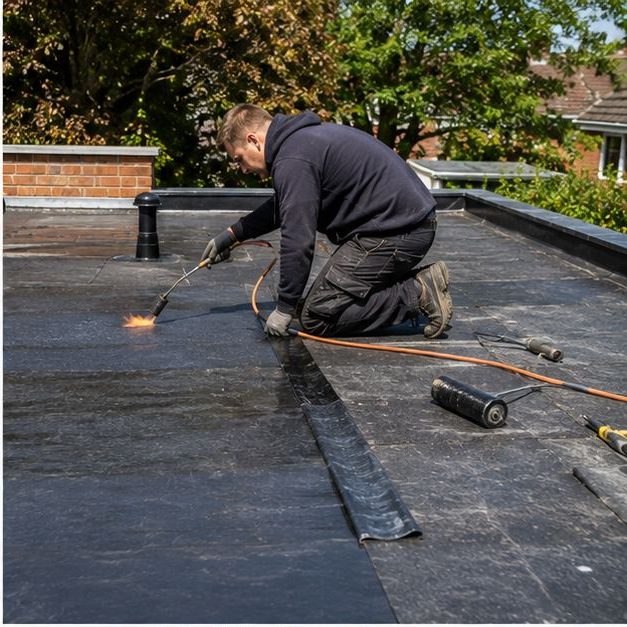
Why the perimeter is the weak point
The edge of a flat roof meets wind, runoff and movement all at once. Materials expand and contract at different rates, so joints open slowly. Where a roof laps over a trim or up a wall, there is always a seam, and seams are where water finds its way in. A sound field of covering means little if the edge is lifting. That is why we always inspect the outer few centimetres of the roof before judging the rest.
How upstands go wrong
An upstand is the covering turned up a wall or parapet. If it is poorly stuck, too short or finished without a proper cover, rain runs behind it. Brickwork joints above can also be open, so water passes behind the upstand from the wall itself. We often find the finishing strip or flashing above an upstand has lifted or been sealed over with mastic, which hides the gap instead of closing it.
- Upstand too low or pulling away from wall
- Cover flashing missing or loose
- Open mortar joints above the roof
- Sealant used where a fixing was needed
Edge trims and drip details
The trim at the edge directs water into the gutter. If it is bent, loose or set at the wrong angle, water runs back under the covering or down the fascia. On larger Henleaze houses with shallow extensions, a rotten fascia or a gutter set too low can cause the same effect. We check trims, the board beneath and the gutter line together. Gutters on these low extensions also take a lot of runoff from the main roof above.
Signs you can see from inside
Look at the ceiling and wall corners beneath the flat roof. Damp patches that follow a wall line often point to an upstand problem. Staining that starts at the outer edge suggests the trim or gutter. A damp smell, bubbling paint or a darkened corner is worth photographing. Do not climb up to check. Call us and we will inspect from safe access.
How we fix it properly
We expose the junction, cut back damaged covering, dry the deck, and renew any rotten edge boards. Upstands are rebuilt at a proper height and finished with a lead or purpose-made cover flashing fixed into the wall. Edge trims are refitted so water runs the right way. Where work may need planning or Building Regulations checks, we advise before work starts.
Frequently Asked Questions
Can I just seal the gap with mastic?
Mastic can slow a leak for a short time, but it cracks as the roof moves and can trap water behind it. A lasting fix means re-forming the upstand or trim, usually with a proper cover flashing.
Why does the leak only show after wind and rain together?
Wind pushes water sideways and up behind edge trims and flashings. A junction that sheds plain rain can fail when driven rain forces its way in. That pattern usually points to an edge or upstand fault.
Will fixing the edge be enough, or is the roof finished?
If the main covering is sound, repairing the edges and upstands can fully solve the problem. If the covering is also breaking down or the deck is soft, we will tell you honestly that more is needed.
Talk to our team about flat roofing in Henleaze
Every roof is different — the fastest way to get an accurate answer is a quick chat with our team.