
Water that cannot leave a flat roof will find a way in. This guide covers how the slope and drainage work on extensions and bays, and how we put problems right.
Every flat roof relies on a gentle slope and a clear outlet to shed rain. If either is missing, water sits, and standing water is hard on any covering. On Bedminster's Victorian and Edwardian terraces, rear extensions, lean-tos and bay tops each have their own drainage, and they are easy to overlook until something stains the ceiling.
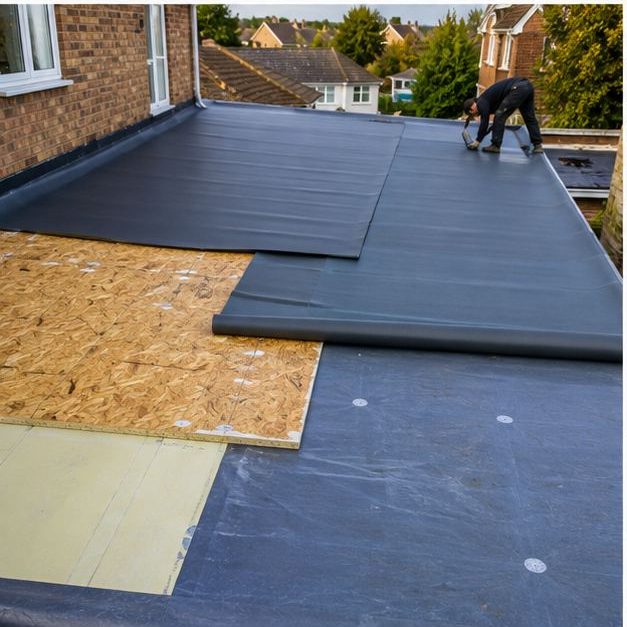
How the slope works
The fall is a slight incline built into the deck or the insulation above it. It sends rain towards the gutter or outlet. If the fall is too shallow, or the deck has sagged, rain pools in the lowest spot. Older extensions often have very little fall, and some lean-tos were never given a proper one at all.
Signs of poor drainage
Look from an upper window after rain. Puddles that sit long after the rain stops show where water is trapped. You may also notice green algae, dirt lines or a slightly sagging surface. Describe what you see or send photographs, and do not step onto the roof to check.
Inside, a ceiling stain that grows after heavy rain suggests water is lingering on the roof. Overflow at the gutter edge is another clue. Inside, a ceiling stain that grows after heavy rain suggests water is lingering on the roof. Overflow at the gutter edge is another clue, as is damp on the wall just below where the roof meets the house, particularly on lean-tos.
- Water lying on the surface long after rain
- Algae or dirt rings marking old puddles
- Gutters overflowing at one corner
- Ceiling stains that grow after heavy rain
Outlets, gutters and awkward access
Gutters and outlets clog with leaves, moss and debris. On terraces with tight rear access they can go unnoticed for ages, and the people who might clear them cannot easily get there. Blocked drainage makes water back up, which then pushes at joints and edges. We check every outlet and trim as part of a flat roof visit.
What it does to the roof
Standing water adds weight, speeds up wear and finds any small flaw. Winter frost makes it worse. If the deck stays wet it can soften and rot, and insulation underneath loses its value. We always check the deck when we find ponding, because fixing the surface alone does not cure a drainage fault.
Fixing falls and outlets
Where the deck is sound, tapered insulation can improve the fall, and new or enlarged outlets can move water away faster. Where the structure has sagged or rotted, it needs repair first. New outlets are positioned to suit the lowest part of the roof so water has a short path to leave.
We assess the roof honestly and explain the options, including whether a repair is enough or whether a fresh covering with corrected falls is the sensible route. We assess the roof honestly and explain the options, including whether a repair is enough or whether a fresh covering with corrected falls is the sensible route. You get a clear written description of what we propose, before any work begins.
Frequently Asked Questions
Do all flat roofs need a fall?
Yes. Even a slight slope helps water leave. A truly level roof will pond, and ponding shortens the life of the covering. We check falls on every flat roof we look at. Even a modest slope, built in correctly, makes a clear difference to how well a roof ages.
Can I clear a blocked outlet myself?
Only if it is reachable safely from the ground or a window. Do not go onto the roof to clear it. If you cannot reach it, call us and we will clear and check it. We can show you the outlet and explain how to keep it clear from a safe spot in future.
Does ponding always mean a new roof?
No. Sometimes clearing outlets or adding a small correction solves it. If the deck has sagged or the covering is failing, replacement may be the better answer. We tell you which. Often the simplest fix is the clean-out; we check before suggesting more.
Talk to our team about flat roofing in Bedminster
Every roof is different — the fastest way to get an accurate answer is a quick chat with our team.