
Painted timber can serve for a long time, but it does give notice when it is failing. This guide covers the signs to look for and the sensible moments to switch.
Rows of Victorian and Edwardian houses in Bedminster have timber eaves boards that have been repainted many times. Eventually the paint stops protecting them. Deciding when to replace comes down to what you can see from the ground, what lies behind, and whether other work, such as gutters or roof repairs, is already planned.
What failing boards look like
From the pavement or garden, look for paint peeling soon after redecorating, dark staining, open joints and boards that have started to bow. Soft or crumbling areas, especially near joints and gutter outlets, point to rot. Gutters that sag or leak at the back are another warning sign.
- Flaking paint that returns quickly
- Boards that are bowed, split or open at joints
- Soft patches, especially near downpipes
- Gutters drooping or marking the wall below
Why water sits at the eaves
The eaves are where water collects: leaking gutters, overflows and roof run-off all hit the fascia. Timber that stays damp rots from the back, often long before it shows. On long terraces, a leaking joint in the gutter can quietly soak the same board for a long time.
Repair, repaint or replace
Where rot is limited to a short length, it can be cut out and repaired. If many boards are soft, or if repainting is a repeating chore, replacing with UPVC makes more sense. UPVC is cleaned, not painted, and is very low maintenance. The rest of the run may still be in good order, in which case a spot repair is perfectly reasonable.
We tell you honestly when a repair will do, and when it will only delay the inevitable. We tell you honestly when a repair will do, and when it will only delay the inevitable. A terrace often has a mix, with the weathered side needing replacement while the sheltered side is fine, and we can split the work that way.
Choosing the finish
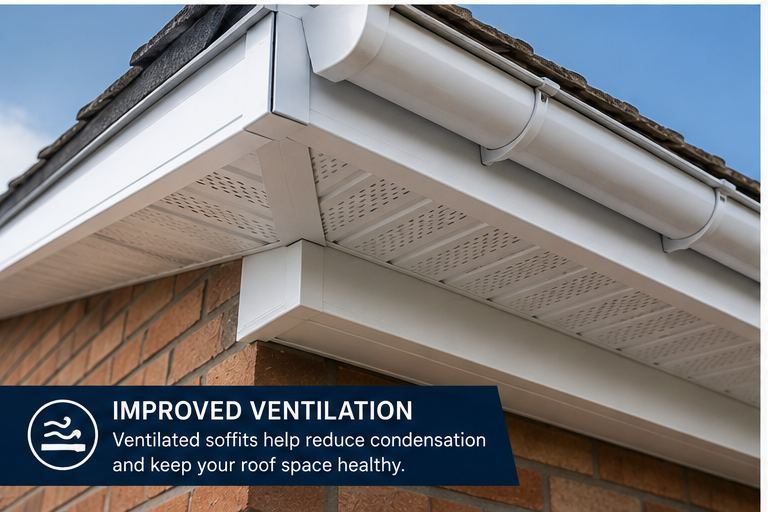
UPVC comes in white as well as darker and wood-effect finishes, so you can keep the look of your terrace or lift it slightly. Bay windows and rear extensions have their own boards, and we make sure they match. Vented soffits or vent strips go in at the same time to let the roof space breathe.
Picking the moment
The best time is when scaffold is going up anyway, such as for gutter renewal, roof repairs or a re-roof. Eaves access in Bedminster can be tight, so combining jobs saves disruption. We check rafter ends once the boards are off and fix anything we find. The work may need planning or Building Regulations checks — we advise before work starts.
Frequently Asked Questions
Can I replace just the worst boards?
Yes, where the rest are sound. But mixing old and new can look patchy and leave rot in the remaining timber. We assess the whole run and tell you what makes sense. A full run looks neater and avoids leaving a patchwork of old and new along the eaves.
Do bay window roofs have fascias too?
Yes, and they are often forgotten. The bay top has its own boards and gutters, and these are exposed to weather. We include them when we look at the eaves. Bay tops take rain from several directions, so their boards often fail earlier than the main run.
Will UPVC stop condensation in the loft?
Not by itself. Vented soffits or vent strips help the roof space breathe, which reduces condensation. We check ventilation as part of the replacement and fit it properly. Condensation also depends on how the loft is used and insulated, so we look at the whole roof space.
Talk to our team about UPVC fascias and soffits in Bedminster
Every roof is different — the fastest way to get an accurate answer is a quick chat with our team.