
A flat roof is never truly flat. It relies on a gentle slope and clear outlets to shed water, and when either fails the covering is the first thing to suffer.
Water that stays on a flat roof does damage slowly and quietly. In Chipping Sodbury, flat roofs usually sit on extensions, garages, porches and dormers added to older and newer homes alike, and each one depends on its falls and drainage working. When they do not, covering, joints and the deck below all pay for it.
What falls actually are
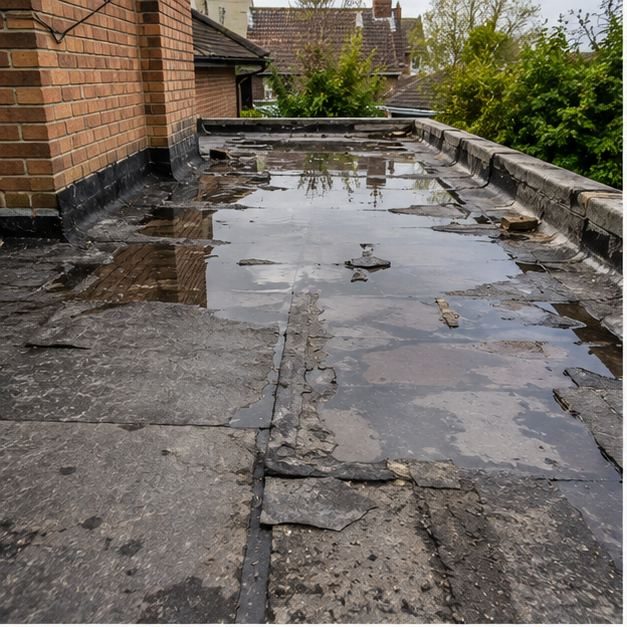
Falls are the slight slope built into a flat roof so water runs towards an outlet, gutter or edge. A roof with good falls dries quickly after rain. One with poor falls, whether built that way or pulled out of shape later, holds shallow pools that sit for days and keep the surface permanently wet.
Older flat roofs on porches and bay tops were often laid with very little fall to begin with, so what looks like a fault may simply be a design limit. In those cases the sensible answer is a fix that improves the way water leaves, not a patch over the same low spot.
Ponding and what it does
Standing water is not always a leak, but it is a warning. It carries dirt and debris, wears the surface and puts constant strain on seams and joints. Over time it finds a weak point. We look at where pools form, how deep they stay, and whether the deck underneath has dipped or softened.
- Pools that remain long after rain has stopped
- Dark stains or algae marking the low points
- A deck that feels spongy from inside
- Seams lifting where water sits
Outlets, gutters and edges
Even a well-sloped roof fails if water cannot leave. Leaves, moss and silt block outlets, and the roof backs up. Edge trims that sit too high hold water back, and gutters that sag or are blocked push it back onto the covering. Exposed Cotswold-edge weather also fills outlets with debris blown from nearby trees.
What you can check without going up
From the ground and indoors you can learn a lot. Look for overflowing gutters, stained walls below the roof edge, and ceiling marks beneath the flat roof. Notice whether water sits visibly after rain from an upstairs window. Do not climb up to clear anything yourself. Tell us what you saw and we will inspect it properly.
How we put it right
Where the roof is sound enough, we clear and repair outlets, reseal joints and correct local low spots. Where the deck has failed or the falls are poor across the whole roof, patching only delays the problem, so we explain when replacement with new falls, insulation and covering makes more sense, and agree the scope in writing.
We also look at insulation and edge details at this stage, since changing the falls can affect upstand heights and the way the edge trim sheds water into the gutter. Getting those right at the start avoids a second visit for the same fault.
Frequently Asked Questions
Is a little standing water after rain normal?
Small damp patches that dry quickly are common. Pools that remain for days are not, because they accelerate wear and put strain on joints. If the same spot stays wet each time it rains, it is worth having the falls and outlets checked.
Can poor falls be corrected without replacing the roof?
Sometimes, where the problem is local and the deck is sound. If the slope is wrong across the whole roof, or the deck has dipped, a full replacement with properly formed falls is usually the honest answer. We explain which applies.
Who clears a blocked outlet or gutter?
We can, as part of a proper inspection and repair. Please avoid climbing up to clear it yourself. If you can see an overflowing gutter from the ground, let us know and we will deal with the outlet and check the rest of the roof.
Talk to our team about flat roofing in Chipping Sodbury
Every roof is different — the fastest way to get an accurate answer is a quick chat with our team.