
A flat roof is only as good as its ability to shed water. Here is how falls and drainage work on the porches and garage roofs around Lockleaze, and what we do when they do not.
Flat roofs on Lockleaze's post-war semis and terraces tend to be small ones: a porch, a garage, perhaps a rear extension. They look simple, yet water behaves badly on them if the slope is wrong or the outlet is blocked. This guide explains what falls are, how drainage fails, and what can be done.
What a fall is
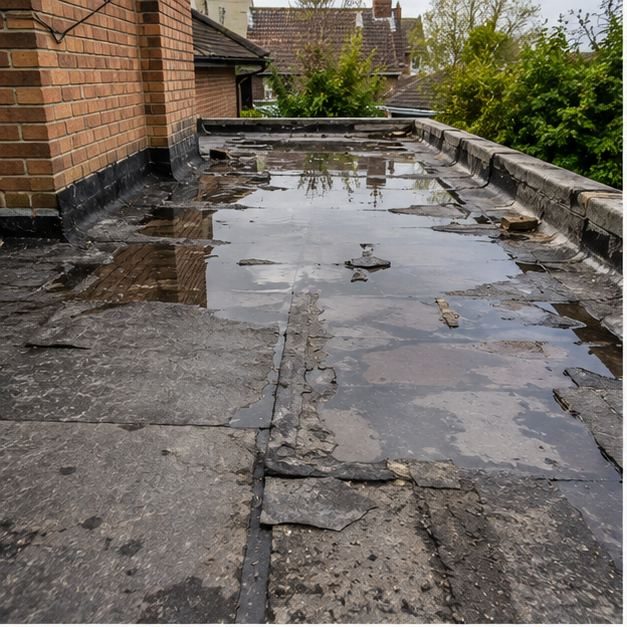
A flat roof is never truly flat. It is laid with a gentle slope, called a fall, so that rain travels towards a gutter or outlet and leaves. Where the slope is too slight, or the deck has sagged, water stops and sits. Standing water is the single biggest sign that something about the roof needs attention.
How ponding shows itself
Look at the roof after rain, from an upstairs window if you can. Shallow puddles that remain a day later, a grey tide mark where water used to sit, or moss and algae growing in one patch all point to ponding. A garage roof that looks perfectly level may in fact be holding water in the middle.
Ponding adds weight and gives the covering a constant soaking, which makes it work harder at every seam and joint. Ponding adds weight and gives the covering a constant soaking, so every seam and joint has to work harder. Left alone, it is how small flaws turn into leaks.
Outlets, gutters and what blocks them
On a porch or garage, the roof often drains into a small gutter on one edge. Leaves, silt and moss build up in the run and stop the water leaving, so it backs up under the edge trim. A blocked outlet can imitate a bad fall. We clear and test the drainage before blaming the slope, so you are not paying for more than the roof needs.
- Gutters clogged with leaves, grit or moss
- Outlets partly blocked at the downpipe
- Edge trims that sit higher than the roof surface
- Joints at the walls where water gathers
Correcting the water flow
If drainage is blocked we clear it. If the fall is poor, options include re-laying with tapered insulation to build a better slope, or replacing the deck where it has softened. We check the deck and joists underneath whenever the covering is opened, because rot can sit hidden below. We explain which option suits the roof in front of us. It also helps to know the roof is draining properly afterwards. We explain the choice and what it is likely to involve before any work starts.
When to ask us to look
Do not wait for a stain on the ceiling. If water is lying on the roof, or the edge trim is overflowing in rain, tell us. A simple look at the surface, the outlet and the underside from inside the building often tells the story quickly, and we give you a straight account of repair against replacement. A short look at the outlet and the surface is often enough to see which way the problem is heading.
Frequently Asked Questions
Is a small puddle on a flat roof a problem?
A shallow puddle that dries within a day is common. Water that stays for days, leaves a tide mark, or grows green patches suggests poor falls or a blocked outlet, and is worth a look before the covering suffers.
Can poor falls be fixed without replacing the roof?
Sometimes. If the covering is sound and the deck is solid, tapered insulation can improve the slope. If the deck has sagged or the covering is failing widely, replacement is more sensible. We check and tell you which applies.
Do I need to clear gutters on a flat roof myself?
Only what you can reach safely from the ground, and never by climbing onto the roof. A blocked gutter on a porch or garage is easy to miss, so we can clear it and check the outlet during a visit.
Talk to our team about flat roofing in Lockleaze
Every roof is different — the fastest way to get an accurate answer is a quick chat with our team.