
Water on a flat roof rarely drips straight down from the hole. This guide follows how we trace a leak on a Lockleaze porch, garage or extension roof, and what the fix usually looks like.
A brown stain on a garage ceiling or a drip inside a porch is where the water ends up, not necessarily where it got in. Flat roofs let water travel along the deck before it shows. Tracing the real source is the part that decides whether a repair lasts, so here is how we go about it.
Start with where and when it drips
We ask when the leak shows: only after heavy rain, after any rain, or even in dry weather with condensation. The answers narrow things down. A leak that follows storms points to a split or failed joint, while a constant damp patch can suggest a trapped moisture problem. Photographs of the stain over time are useful.
Reading the surface
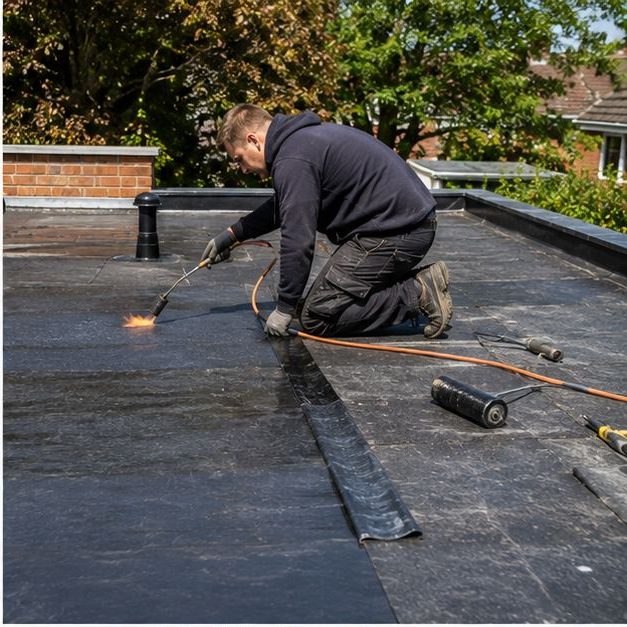
Then we look at the covering itself. We check for splits and blisters, joints that have opened, lifted edges, and worn patches. We look closely at the places water loves to enter: the upstands where the roof meets a wall, the edge trims, around any pipe or rooflight, and the outlet.
On the single-ply, fibreglass or felt systems typically found on garages and porches, each material fails in its own way, so the sort of damage tells us a lot. Each material fails in its own way, so the kind of damage we see tells us a lot about where water is getting in.
Checking underneath
Inside, we look at the ceiling, the timbers and any insulation, which can reveal damp tracking back from the visible stain. If the deck is soft or dark with moisture, the problem may be wider than a single hole. We press gently and look for rot, because a rotten deck changes the whole decision about repair or replacement.
- Stained or crumbling plasterboard below the leak
- Dark, soft or spongy deck timber
- Damp insulation that has lost its effect
- Tide marks following the line of joists
Repair or replace
Where the covering is sound apart from a localised fault, we repair it: patching a split, renewing a failed joint, resealing an upstand, or clearing an outlet. Where damage is widespread, the deck is rotten or the roof has reached the end of useful repair, we will say that plainly. Patch after patch on a failing roof does not save you anything. We will show you photographs of what we found, so the decision is yours to make with the facts in front of you.
What to expect from us
You get an explanation of what we found and why the water was getting in, what we propose, and whether it is a repair or a replacement. We tell you what is urgent and what can wait. The work is done tidily, any waste is removed, and we are happy to answer questions as we go.
Frequently Asked Questions
Why does the leak appear away from the actual hole?
Water follows the deck, the felt or the insulation and drops out at the lowest or weakest point. That is why a stain can be some distance from the real fault, and why we trace it rather than patching the stain.
Can a leaking flat roof be patched in bad weather?
Temporary protection is possible, but a lasting repair needs a dry surface for the covering to bond properly. We can make the roof safe first, then return to complete the proper repair when conditions allow.
Will you tell me if the whole roof needs replacing?
Yes, and we will explain why. If a repair is sensible we will do that. If the covering has failed widely or the deck is rotten, we will show you the evidence and talk through the options.
Talk to our team about flat roofing in Lockleaze
Every roof is different — the fastest way to get an accurate answer is a quick chat with our team.