
After a gale the first job is working out what actually moved. Here is how to check a Lockleaze semi or terrace safely from the ground and the loft, and what happens when we call.
A strong wind finds the weak spots on a post-war estate roof quickly: a tile on the lawn, a gutter pulled away, a porch covering lifted at one corner. Most of what you can safely do happens with your feet on the ground or inside the loft. This guide covers what to look for, what to keep well away from, and when to ask us round.
Start with a walk round the outside
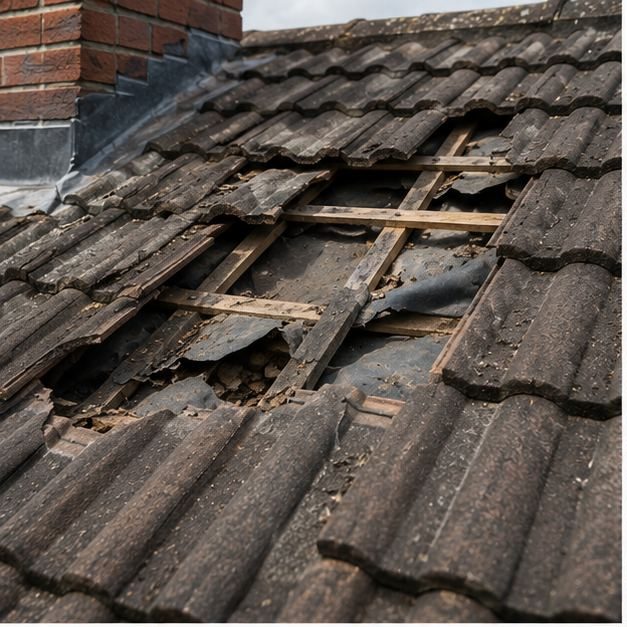
Once the wind has dropped, walk round the house and look up from a safe distance. On the simple pitched roofs common around Lockleaze, damage tends to show as gaps in the tile pattern, a line of ridge pieces out of true, or a gutter sagging at one end. Check the lawn, path and drive for broken tile or slate.
Take photographs as you go, including anything lying in the garden. They help us understand what has come off and from where, and they are useful if you decide to tell your insurer. Even a rough record of the date and time of the storm helps us work out which direction the wind came from.
- Slipped or missing tiles showing as dark gaps or uneven rows
- Ridge pieces that look lifted, tilted or cracked along the top
- Gutters hanging, sagging or pulled away from the fascia board
- Fallen debris such as tile pieces, mortar or loose lead
Keep off the roof and away from the fall zone
Do not climb up to look, and do not lean a ladder against the eaves to take a closer peek. Wet tiles are slippery and a damaged roof can give way underfoot. Keep children and pets away from the area below any loose material, because pieces can still drop in a gust. If something looks about to fall onto a path, cone it off or keep people clear and call us. Keep any unsecured items, such as bins and garden furniture, away from the house as well.
Check the loft and the ceilings
Water often arrives after the storm, not during it, so look inside as well. With a torch, check the loft for daylight where there should be none, damp patches on the felt, and dark staining on rafters. Look at upstairs ceilings and the area above the porch for new brown marks.
Put a bucket under any drip and move belongings out of the way. Do not poke at a wet ceiling that is bulging; leave that for a proper look. If the ceiling looks swollen with water, keep well clear of it and call us rather than trying to release it yourself.
What we do when we come out
We inspect the whole roof, not only the spot you noticed, because wind rarely takes one tile and stops. We look at the ridge, the verge edges, the lead around chimneys and the covering around porches and garages. You get a plain explanation of what is urgent, what can wait, and whether a repair is sensible or the covering is tired enough to justify more work.
Temporary protection and proper repair
Where water is getting in, a temporary fix can stop the damage spreading while a proper repair is arranged. A proper repair means replacing broken tiles, refixing slipped ones, re-bedding loosened ridge pieces and putting back any lead that has lifted. We explain what we are doing and why, and we clear the debris when we finish.
- Ask what was found, not just what was fixed
- Ask whether the work is a temporary measure or a lasting repair
- Ask for the description of work in writing before it starts
Frequently Asked Questions
Can I wait until the weather improves before calling?
If water is coming in or something is hanging loose, do not wait. If it is only a few slipped tiles and the loft is dry, a short delay is reasonable, but keep checking inside. Unattended gaps let rain soak the felt and timbers, which turns a small job into a bigger one.
Should I take photos before anyone touches anything?
Yes, from the ground and from inside the loft where safe. Pictures of the damage and any fallen pieces show what happened and when you noticed it. They also help us talk through the repair with you before we arrive.
Is a storm repair always going to be small?
Not always, but it often is on simple pitched roofs. We can only say once we have looked at the whole roof. Sometimes wind exposes an older problem, such as tired ridge mortar or brittle tiles, and we will tell you plainly if that is the case.
Talk to our team about roof repairs in Lockleaze
Every roof is different — the fastest way to get an accurate answer is a quick chat with our team.