
Water that cannot leave a flat roof does lasting harm. This guide explains falls and drainage on Longwell Green's garage and extension roofs, and how we correct them.
Garages and rear extensions are a feature of Longwell Green's later 20th-century homes, and many of them have a flat roof. These roofs depend on a small slope and a working outlet to keep dry. When either goes wrong, water lingers, and the covering pays for it. Here is how it works.
The slope you cannot see
Every flat roof should fall gently towards an outlet or gutter. The slope can be so slight that you would never notice it from the garden. If the deck sagged, the roof was laid with too little fall, or later work changed the levels, water settles in the low spots instead of leaving. Because the fall is gentle, it can only be judged by looking at how the water behaves.
Signs that water is not leaving
After rain, look at the roof from an upstairs window if you can. Puddles that stay for days, tide marks on the surface and patches of algae show where the water gathers. Overflowing gutters or streaks on the wall beneath are warnings too.
Constant standing water speeds up wear on joints and edges and adds weight to the structure. The weight alone puts extra strain on the deck, and slow, steady wetting is what ages a covering fastest of all. That is why drainage checks come first.
Blocked outlets and gutters
Leaves, grit and moss collect in small gutters and outlets, and then the water backs up behind them. On a garage roof near trees it can happen fast. We clear and test the drainage first, because sometimes what looks like a bad fall is a blocked run, and clearing it costs the roof far less than a new covering.
- Debris in gutters and at the outlet mouth
- Downpipes partly blocked or disconnected
- Edge trims that trap water at the lip
- Splash marks and moss along the gutter line
Putting the flow right
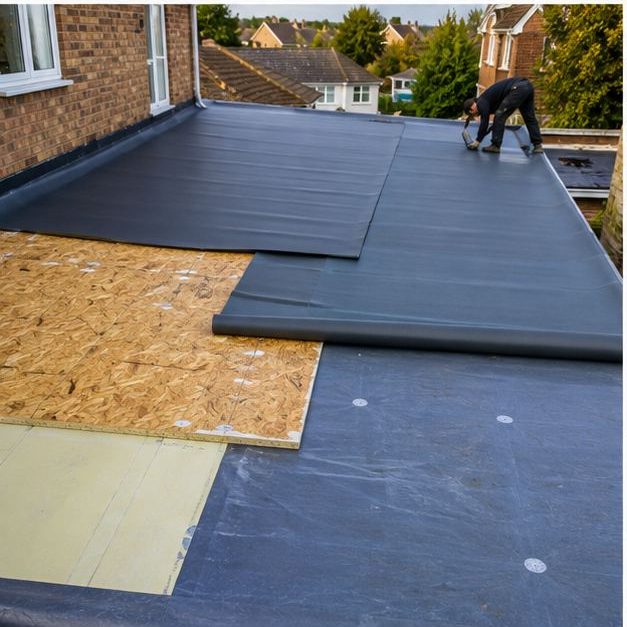
Where the fall is poor, a new covering can be laid over tapered insulation to create a better slope. Where the deck has sagged or softened, we replace the affected boards first. We also check outlets and the edge detail so water has a clear way off. The approach depends on what the roof underneath tells us once it is opened up.
Why it matters to the whole roof
Good drainage protects the covering, the deck, the walls and the ceiling beneath. It also lets you see which faults are minor. If your roof holds water, ask us to look before the covering fails. We advise on whether clearing, repair or replacement fits the roof, and we explain the reasons so you can choose with confidence. We would rather clear a blockage than sell you a new roof you do not need.
Frequently Asked Questions
Is some standing water normal?
A shallow film that clears within a day is common. Water that stays much longer, or leaves a tide mark, suggests poor falls or a blockage and is worth investigating before the covering is harmed.
Can a roof with poor falls be saved?
Often, if the deck is sound. Tapered insulation under a new covering can improve the slope. If the deck has rotted, that is repaired first. We tell you plainly which route suits the roof.
Who clears blocked gutters on a garage roof?
From the ground you can do what is safely reachable. Anything that needs access to the roof should be left to us. We can clear the outlet and check the drainage at the same visit.
Talk to our team about flat roofing in Longwell Green
Every roof is different — the fastest way to get an accurate answer is a quick chat with our team.