
Slipped and cracked tiles rarely come from one cause. Age, wind, movement in the structure and past repairs all play a part, and the cause decides whether a patch or a bigger job is right.
Walk down a Fishponds street and you will see roofs from several periods side by side: Victorian and Edwardian terraces, inter-war semis and later extensions. Each ages differently, and a tile that has slipped or cracked is usually telling you something about the roof underneath it rather than just the tile.
Why tiles slip
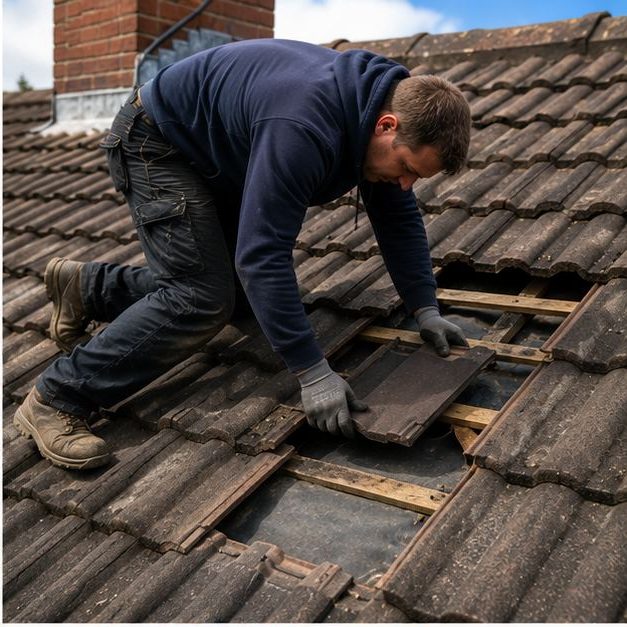
A tile stays put because of its nails, its clips and the batten beneath it. When nails corrode, battens soften or the felt below fails, the tile loses its hold and creeps down the slope. You often see a tile sitting proud of its neighbours, or a gap opening up that shows the dark underlay behind.
Extensions and loft conversions add another factor. Roof slopes that have been cut into or altered can leave tiles resting on newer timber that has moved slightly, which loosens the fixings along the join with the older roof and lets tiles drift.
Why tiles crack
Cracks come from several directions. Frost gets into a porous tile and splits it. A branch, a ball or a careless foot breaks it. Roofs that have been walked on by aerial fitters or chimney sweeps often carry hidden cracks, and an old tile can simply become brittle. A cracked tile may look sound from below until rain finds the split.
What the wider roof is telling us
Several slipped tiles in one area point to failing battens or fixings, not bad luck. Cracks near a chimney or valley suggest movement or water collecting there. On older terraces we look at the whole slope, not only the damaged spot, so a repair is not undone by the next gust.
- Tiles slipping in rows suggest tired fixings or battens
- Cracks clustered near flashings suggest water or movement
- Moss and debris trapped behind tiles hold moisture against them
- Different tile types on one slope show earlier patch repairs
Repair or replace the covering
A few damaged tiles on a sound roof are a straightforward repair: we lift the tiles, fix them properly, replace broken ones with a close match and check the felt beneath. If battens are rotten or the felt is perished across a wide area, patching becomes false economy and we will say so, with the reasoning, before you decide.
What to check from the ground
Look for tiles out of line, small fragments in the gutter or on a flat roof below, and stains on ceilings or in the loft. Do not go up to investigate. A loft visit with a torch, looking for daylight or damp timbers, tells you a good deal, and then we can inspect the roof itself.
If you cannot tell a slipped tile from a fault in the felt, that is normal. The roof surface hides a great deal, and a visit with a proper look at both the covering and the loft usually settles the question quickly and clearly.
Frequently Asked Questions
Can one cracked tile cause a leak?
Yes, especially if it sits over a joint in the felt or near a flashing. The water drips onto the underlay and runs along it until it finds a way in, which may be some distance from the crack.
Is it worth replacing a single slipped tile?
Usually yes, and quickly, because an open gap lets wind lift neighbouring tiles. We re-fix it, check the batten under it and look at nearby tiles to make sure the same problem is not spreading.
Will the replacement tiles match?
We aim for the closest match in colour, profile and weathering. On older roofs an exact match can be hard to find, so we may take tiles from a less visible slope or use reclaimed ones, and we explain the options.
Talk to our team about roof repairs in Fishponds
Every roof is different — the fastest way to get an accurate answer is a quick chat with our team.