
A dry verge swaps patched mortar for a neat, factory-finished edge. Here is how it looks on the gable ends of Lockleaze's semis and terraces, and what you will and will not notice.
Look along the gable edges of Lockleaze's post-war streets and you will see a mixture: some verges neat, some patched with mismatched mortar, some stained and cracked. A dry verge changes that appearance noticeably. It is also about more than looks, but the finish matters to most owners. Here is what the change actually looks like.
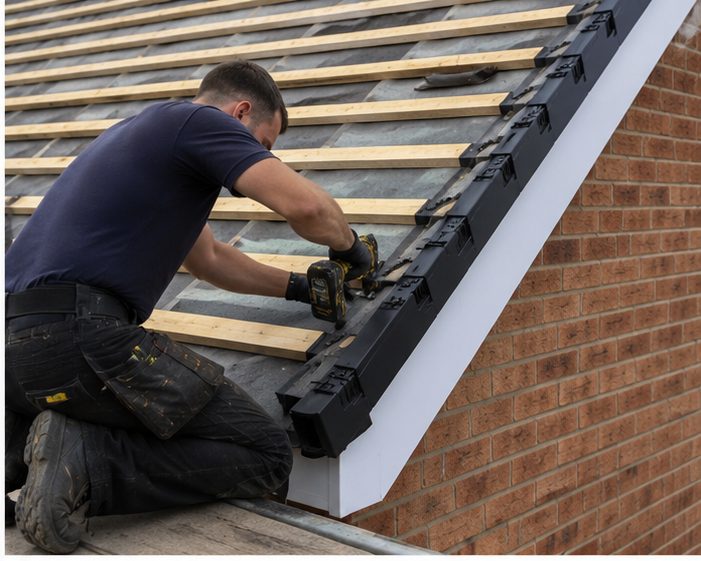
From uneven mortar to a straight edge
A mortar verge is hand-finished, so it varies. Over time it picks up cracks, stains and patches of repair in slightly different colours. A dry verge uses made units that run straight along the roof edge, giving a consistent line. On a plain pitched gable, which is what most estate houses have, that straight edge is easy to see from the street.
Colour and profile
Verge units come in colours chosen to sit with the roof covering, commonly in darker tones. We match the unit to the tile as closely as is sensible, since the right profile also affects how it fixes. Cap and tile-end pieces finish the top and bottom of the run.
The result usually looks cleaner and a bit more modern than old mortar, but it does not look out of place on an older roof. Cap and tile-end pieces finish the top and bottom of the run, so the whole edge looks consistent from the street.
What happens to the edge detail
With mortar gone, there is no wet line sitting against the tile ends, so no staining where it used to run. The overhang and edge shadow often look sharper. On a garage or porch gable, which are small, the change is just as visible. Neighbours on a terrace may notice the difference where one house has a new verge and the next does not.
- Straighter line along the whole gable edge
- No cracked or patched mortar to catch the eye
- Consistent colour from top to bottom of the slope
- Tidier junction at the ridge and the eaves
Why the look is only part of it
The point is performance: the units are mechanically fixed, so they resist wind at the edge, there is no mortar to fail, and weather, birds and insects stay out. A good-looking verge that blows off would be no use. Everything is fixed to the tile maker's guidance, and compatibility depends on the tile profile, which we check on site.
What to ask before agreeing
Ask to see the unit colour and profile before work starts, and ask how it will meet your existing tiles. We talk this through on site, along with whether anything else on the roof needs attention. If the roof is failing elsewhere, a dry verge will not fix that, and we will tell you so. Seeing a sample against your own tiles removes most of the guesswork.
Frequently Asked Questions
Will a dry verge look very different from my current one?
Usually it looks neater and more uniform than old mortar, but the roof covering itself does not change. We explain the colour and profile choices so there are no surprises when the work is done.
Can I choose the colour?
Within the range suited to your tile, yes. We talk through the options on site, because the right unit has to fit the tile profile and suit the roof as a whole. Colour and profile are agreed with you before work starts.
Does the work disturb the rest of the roof?
Only the edge is worked on, though we check nearby tiles and the battens as we go. If something else needs attention, we point it out rather than quietly adding to the job.
Talk to our team about dry verge systems in Lockleaze
Every roof is different — the fastest way to get an accurate answer is a quick chat with our team.