
A tile does not move for no reason. This guide explains the usual causes behind slipped and cracked tiles on Lockleaze's post-war semis and terraces, and how we deal with the roof, not just the tile.
If you have spotted a tile sitting lower than its neighbours, or a cracked one lying in the gutter, it is worth asking why before paying for a quick fix. On the plain pitched roofs of Lockleaze's estates the causes are usually few and findable. Here is what tends to go wrong and what we look at on the day.
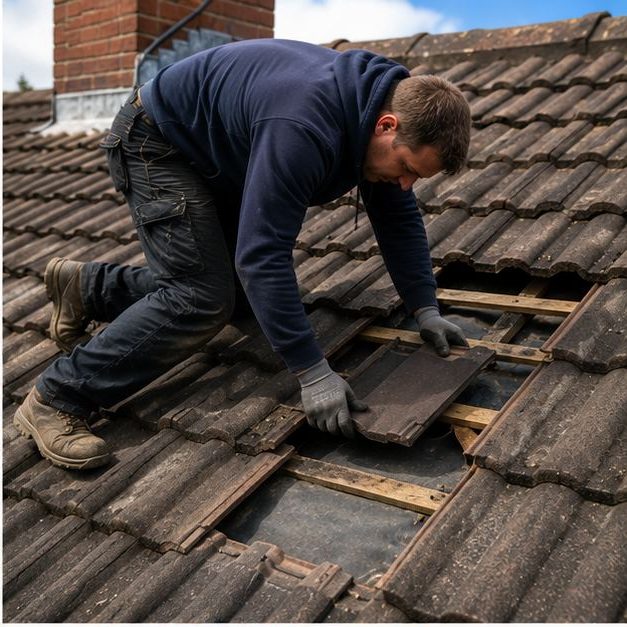
A tile only slips when something has let go
Each tile hangs from a batten by a nib and is held by its neighbours, with nails or clips on some courses. When one slides, either the nib has broken, the nail has corroded, or the batten underneath has weakened. So the slipped tile is the visible symptom. We lift it and the ones around it to see what has actually failed before refitting anything.
Why tiles crack
Cracks come from a few sources: age and weathering, a knock from a fallen branch or a ladder, or foot traffic from someone who has been up on the roof. Frost can also get into a porous tile and open it up over many winters.
Hairline cracks may do little for a while, but a split that runs through a tile lets water onto the felt. We judge each one by whether water can take a route through it. We also look at whether the cracking is on one slope only, which tells us if weather or an impact is the likelier cause.
Movement, wind and the shape of the roof
Simple pitched roofs with long open slopes catch the wind, and repeated gusts loosen fixings gradually. Garage and porch roofs sit lower and can be overlooked, yet they get the same weather. The edges and ridge line take the most pressure, so slipped tiles often cluster there rather than in the middle of a slope.
What we check on the day
We look from the ground first, then closely at the affected area, working out whether it is one tile or a pattern. Underneath we check the felt, the battens and the loft side for staining or daylight. If the same fault shows across a whole slope, we will say so honestly rather than patch one spot at a time.
- Condition of the nails, clips and battens behind the tile
- Signs of water on the felt or timbers in the loft
- Matching tiles available for the repair
- Ridge and edge pieces nearby that may be loose
Putting it right
A proper repair replaces cracked tiles, refixes slipped ones securely and renews anything underneath that has failed. We explain whether a handful of tiles will do or whether the covering is reaching the point where a larger repair makes better sense. You get a clear description of the work before we start, and we leave the site tidy. We also tell you what we saw underneath, so you can judge for yourself whether the repair makes sense.
Frequently Asked Questions
Can I push a slipped tile back into place myself?
Please do not go on the roof to try. It is unsafe, and pushing a tile back without finding why it moved usually means it moves again. Take a photo from the ground and call us for a proper look.
Is one cracked tile worth repairing?
Usually yes, because a cracked tile can pass water onto the felt below. The cost of waiting is rotting battens and damp in the loft. We look at the surrounding tiles at the same time, so any other weak spots get sorted together.
Do slipped tiles mean the whole roof needs replacing?
Not necessarily. A few slipped tiles after wind is common and repairable. If we find widespread brittle tiles or failing fixings across a slope, we will explain that and talk through your options without pressure.
Talk to our team about roof repairs in Lockleaze
Every roof is different — the fastest way to get an accurate answer is a quick chat with our team.