
Replacing fascias and soffits is more than swapping boards. Here is what happens on a typical Lockleaze semi or terrace, from scaffold to the final gutter fitting.
People often assume new fascias and soffits are a quick board swap. In practice the job runs in a set order, and a good deal of it happens before any new board is fixed. On a typical Lockleaze semi or terrace, with its plain pitched roof, it goes roughly like this.
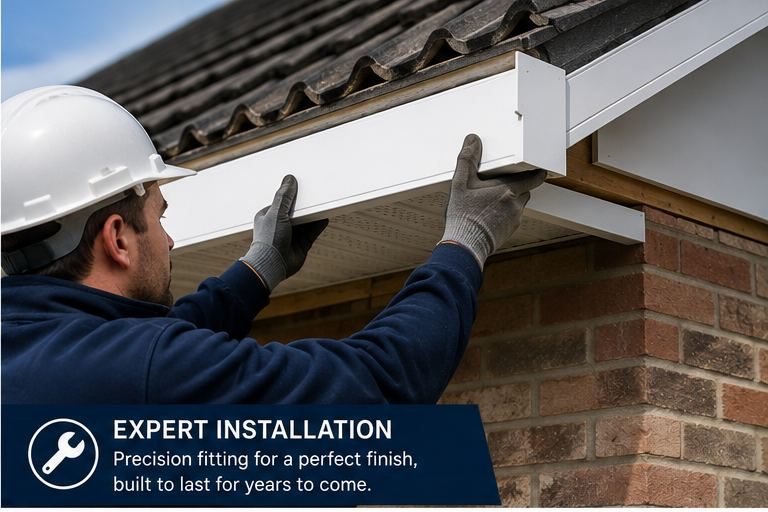
Access comes first
To work safely at the eaves we need proper access, usually scaffold or a tower at the front and back. Short terraces and semis may be quicker to set up than larger houses, but safety does not change. Arranging the access properly means we can work steadily, and it avoids anyone leaning from a ladder at the gutter line. We agree where the scaffold goes with you first.
Taking the old boards off
The gutters come off first, then the old fascia and soffit boards. Taking them away shows what is behind: rafter ends, wall plate, and the felt where it runs into the gutter. This is the moment we find out whether the timber is sound.
Where an older home is involved, we check what the existing soffit boards are made of before disturbing them, and plan the work around that. That check decides how much preparation the new boards need before they go on, and keeps surprises to a minimum.
Checking the rafters and eaves
We look carefully at the rafter ends, the felt line, and the area where water may have been getting in. Rotten ends are cut back or treated, and sometimes a short length is added so the new board has a firm fixing. If the roof felt has lost its drip into the gutter, we sort that before closing up.
- Rafter ends tested for soft spots
- Felt checked to make sure it drops into the gutter
- Ventilation gaps checked for spiders, nests or blockages
- Wall plate area checked for damp
Fitting the new boards and ventilation
New UPVC fascias go on to the rafter ends, with soffits fixed beneath, finishing at the corners and the gable edges with matching bargeboards where needed. We use vented soffits or vent strips so air moves through the roof space and helps keep the timbers dry. Joints are made neat, and white, darker or wood-effect finishes can be chosen.
Gutters and clearing up
Gutters are refitted or replaced and tested so water flows to the outlets. Finally the scaffold comes down, old boards and fixings are cleared away, and we walk you round to show what was done. The boards need only a wipe down now and then, which makes them very low maintenance. Some work may need planning or Building Regulations checks, and we advise before work starts. We also point out anything else we noticed at the roof edge.
Frequently Asked Questions
Will the work make a mess of my garden?
We lay sheets where we can and clear debris as we go, but scaffold and old timber are unavoidable. We finish with a proper tidy-up and check the drive and borders. Neighbours are kept informed where we can.
Do I have to be home while the work is done?
Not usually for the outside work, though it helps to be reachable for decisions if we find hidden rot. If we need to access the loft, we arrange that with you in advance.
Why are vented soffits worth having?
Roof spaces need air to move through them, otherwise moisture builds up and can lead to condensation on the timbers. Vented soffits or vent strips keep that air flowing without letting in birds or insects.
Talk to our team about UPVC fascias and soffits in Lockleaze
Every roof is different — the fastest way to get an accurate answer is a quick chat with our team.