
A drip in the ceiling rarely sits under the hole. Tracing a flat roof leak means working backwards from the stain to the real entry point.
Water on a flat roof moves sideways along the deck and insulation before it appears indoors, so the stain on your ceiling can be some distance from the fault. On the extensions, garages and porches of Warmley, from Victorian additions to later estate homes, tracing a leak is a step by step job.
Reading the signs inside first
We start with what you can tell us: when it leaks, whether only in heavy rain, and where the marks first appeared. Inside, we look at the ceiling, the walls at the junction with the main house and any light fittings. A leak that only shows in driving rain points to a different source than one that appears after a dry spell.
Photographs of the stain over a few days help, and so does noting the weather. We use that history alongside what we find on the roof, so the answer comes from evidence rather than a guess, and the repair goes where the water is really getting in.
Looking over the whole surface
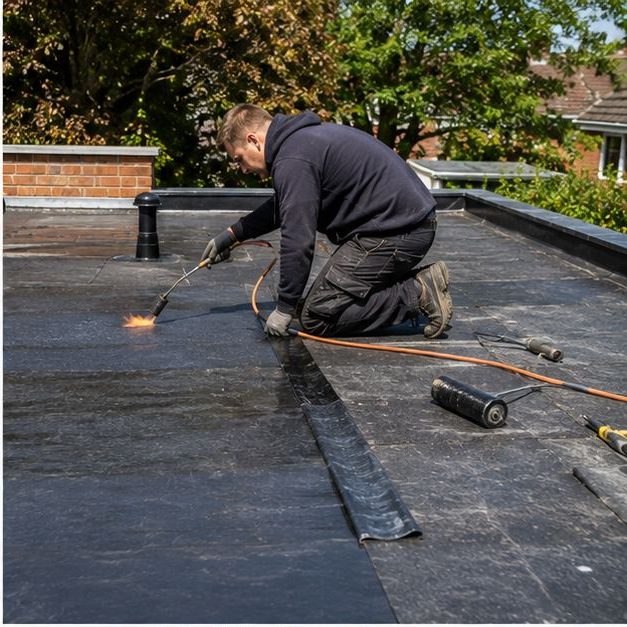
On the roof we examine the covering closely for blisters, splits, open laps and punctures. Then we check the usual weak points: joints around upstands, the abutment with the house wall, edge trims, roof lights and outlets. Most flat roof leaks start at a detail rather than in the middle of a clean sheet.
- Cracks and splits in the covering
- Failed joints or lifting laps
- Gaps at upstands and wall junctions
- Blocked outlets causing water to back up
Testing the deck and insulation
If the surface looks sound but the leak continues, water may be entering elsewhere and travelling under the covering. We check whether the deck feels soft, whether the insulation is wet and how far the damp spreads. This tells us whether a local repair will hold or whether the problem is wider.
Repair where sound, replace where widespread
A small split or failed joint can often be repaired neatly with compatible material. But patching a covering that is failing everywhere only buys a short pause. When the deck is rotten or the covering is worn across the roof, we say so and explain replacement in single-ply rubber, fibreglass or felt options.
What to ask before work starts
Ask for a written description of what was found, where the water was getting in and what will be done. Ask whether the deck will be checked, and what happens if rot is found underneath. A straight answer to those questions tells you most of what you need to know about who you are dealing with.
Also ask whether any replacement covering will be compatible with the existing roof, how the edges and upstands will be finished, and how the area will be left once the work is done. Sensible answers show a roofer has thought it through.
Frequently Asked Questions
Why does the leak appear away from the damaged spot?
Water runs along the deck, insulation and joints before it finds a way through the ceiling. The point where it drips can be well away from the hole. That is why we trace it properly instead of patching the stain's position.
Can a leaking flat roof be fixed in rain?
We can assess it and make temporary protection, but a lasting repair needs the surface dry so new material bonds properly. We will tell you honestly what can be done straight away and what needs to wait for better weather.
Does a leak always mean a new roof?
No. Many leaks come from one failed joint, a cracked trim or a blocked outlet and are repaired. A new covering becomes sensible when problems are widespread or the deck below has deteriorated. We will show you what we found before recommending either.
Talk to our team about flat roofing in Warmley
Every roof is different — the fastest way to get an accurate answer is a quick chat with our team.