
A flat roof is never truly flat. It is built to shed water, and when the slope or the outlets fall short, the covering suffers first.
The word flat is misleading, because every flat roof needs a gentle fall so water runs off instead of sitting. Around Warmley, with Victorian houses, older buildings and later estates all carrying extensions, garages and porches, we see the same pattern: water that cannot leave is the main thing that shortens a flat roof's working life.
What a fall actually is
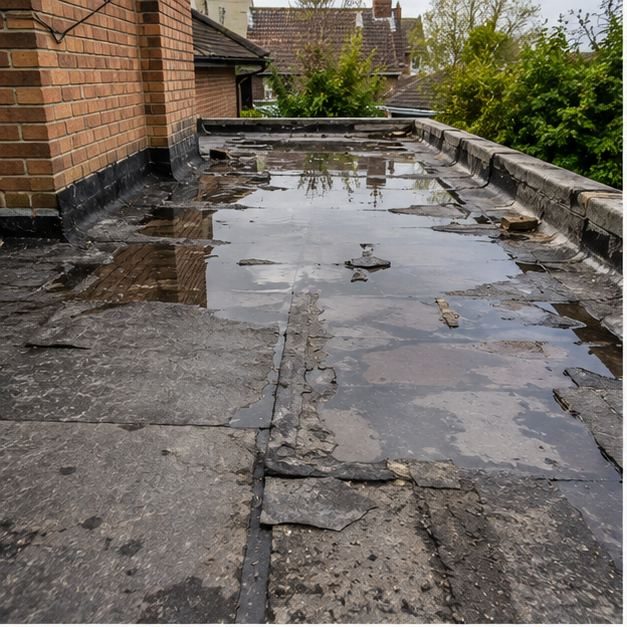
The fall is a slight slope built into the roof deck or its insulation layer, directing water towards an edge, gutter or outlet. A roof built with too little fall, or one that has sagged since, leaves hollows. Those hollows hold water after every shower, and the covering sits wet far longer than it should.
On older additions to Victorian houses the original fall may have been shallow from the start, and settling since then makes it worse. Newer estate extensions can have the opposite fault, where a neat roof was laid without enough slope to reach the outlet.
Why standing water does harm
A puddle that lingers for days is not just untidy. Water presses on seams and joints, algae and grit gather, and freezing and thawing work on any weak spot. Over time the covering weakens, joints open and water finds its way to the deck beneath, where timber can start to rot unseen.
- Seams and laps that open up under constant moisture
- Surface dirt and algae building up in the hollows
- Frost forcing small defects wider over winter
- Deck timber softening beneath a failed patch
Outlets, gutters and edge trims
Even a well-sloped roof fails if the outlet is blocked. Leaves from nearby trees, moss and silt clog outlets and gutters, and water backs up onto the roof. We check that outlets are clear, correctly positioned and joined cleanly to the covering, and that edge trims are tight enough to throw water into the gutter.
Correcting poor falls
Where a roof ponds badly, we look at why. Sometimes new insulation can be laid in tapered form to build the fall back in. Sometimes the deck itself has dropped and needs repair. A thin patch on top of a hollow only hides the problem, so we explain which route makes sense before work starts.
If new insulation is part of the plan, that is a good moment to sort out the fall as well, because the roof is open and the layers can be set out correctly. Doing both together is usually more sensible than returning to the same roof twice.
What you can watch for yourself
From a window or the ground, look at the roof a day or two after rain. Water still sitting is a sign. Inside, look for stains on ceilings below. Do not walk on the roof to clear it. Call us, and we will check falls, outlets and the covering together.
Frequently Asked Questions
Is a little standing water normal on a flat roof?
A thin film that dries off within a day is not unusual. Water that stays for days, or leaves a tide mark and dirt ring, suggests the fall is poor or an outlet is restricted. It is worth having checked before the covering is damaged.
Can falls be added without replacing the whole roof?
Sometimes. Tapered insulation or a new layer can build a fall onto a sound deck. If the deck is rotten or the roof is failing widely, replacement is the more honest answer. We look at the deck condition first.
Who clears blocked outlets?
We can clear and check them as part of a roof visit. Keeping trees cut back and outlets free of leaves helps, but do not climb up to do it yourself. Tell us if water backs up and we will take care of it.
Talk to our team about flat roofing in Warmley
Every roof is different — the fastest way to get an accurate answer is a quick chat with our team.